

Dispatch 37
Who pays for the newsroom?
Cyber Territories · Patrick Lacroix · 29 November 2026
On Thursday, Belgium’s competition authority told Rossel that it could sign its merger with IPM. Three days earlier, the French authority had cleared Rossel’s purchase of Groupe Sud Ouest. In one week, the publisher of Le Soir received permission to bring Sudinfo, La Libre, La Dernière Heure and L’Avenir into a single Belgian group, and to add Bordeaux to a French business that already includes La Voix du Nord.
Bernard Marchant, CEO of Rossel and President of Belga News Agency, explains the logic with figures. A newsroom pays its reporters every month, whatever the advertising market does. For twenty years, much of the money that used to finance that work has gone to global platforms. In Belgium, the federal support for newspaper delivery ends on 31 December, and the public broadcaster offers its written news for free. Scale is his answer to a market in which the costs of journalism remain local and a large part of the revenue does not.
The same week raised a second question: what does a platform actually pay for? Apache reported that Mediahuis receives €40 million from Google, and the debate that followed mixed a product contract, a legal right and an AI licence. For Belga, the legal answer is less favourable than for its French colleague AFP. I explain why the agency still prefers to invoice its journalism directly.
Two further chapters complete the picture. AI agents are becoming a second kind of reader, and the evidence suggests that people keep paying for journalism they trust. Meanwhile, the European information space came under pressure from several sides at once: a cyberattack on AFP, a Russian and Chinese media forum in Moscow, a campaign impersonating newsrooms in Spain on election day, and a French presidential candidate who wants tougher penalties for journalists.
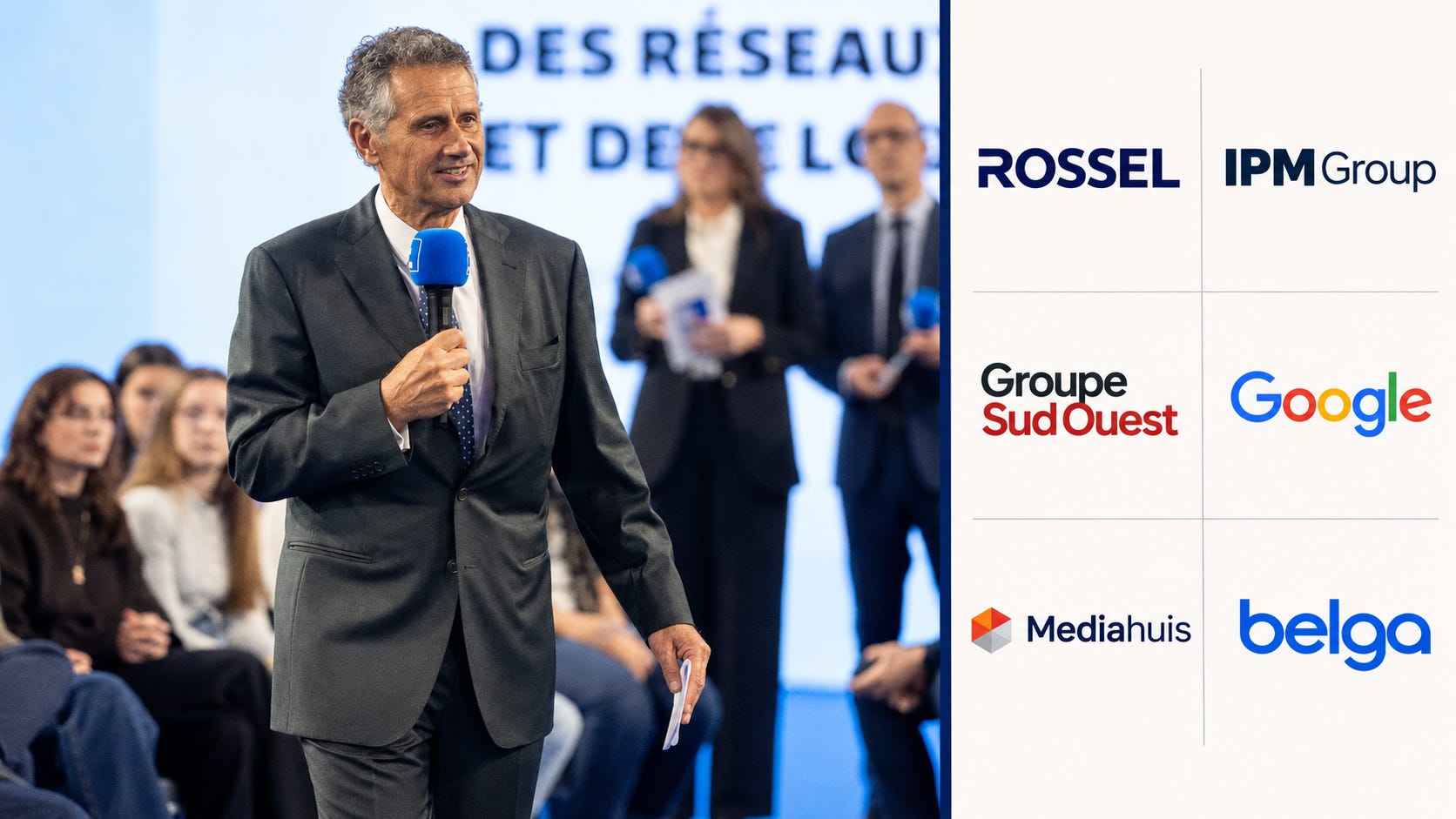
Bernard Marchant, CEO of Rossel and President of Belga News Agency in Arras, 19 November 2025. Photo: Pascal Bonniere / La Voix du Nord / PhotoPQR / MaxPPP, via Belgaimage (image no. 142727785).
I. On Scale
Two approvals, one strategy: a publisher seeks enough size to keep paying for journalism, technology and distribution.
37.1 Rossel gets two approvals in one week
Signal. On 27 November, Le Soir reported that the Belgian Competition Authority considers Rossel’s editorial charters satisfactory, which allows the IPM merger to be signed in the coming days. On 24 November, France’s Autorité de la concurrence cleared the purchase of Groupe Sud Ouest without conditions, because the circulation areas of the regional titles do not overlap. According to Rossel’s announcement in September, the combined French group will have more than €400 million in revenue, 3.4 million daily print readers and nearly 230 million digital visits a month.
Dispatch. Thierry Hugot, Rossel’s commercial and marketing director, told The Media Leader that critical size has become indispensable. He lists what size buys: shared digital tools, a stronger position in negotiations with platforms, and an advertising sales force that can compete. In his account, Rossel’s revenue has changed from roughly half advertising and half readers to 80 per cent readers and 20 per cent advertising. For the moment, the group has closed its content to AI companies and is developing conversational tools for its own sites with Mistral.
Rossel is part of a wider European pattern. McKinsey counts almost half as many media and consumer technology deals in Europe as in 2018, with average deal size up by 30 to 40 per cent, and warns that “the cost of remaining subscale in a consolidating industry can compound with delay.” Bonnier News agreed to take over Ireland’s Business Post Group; in Norway, Schibsted, Amedia and Polaris Media set up a joint advertising technology company, which shows that publishers can also gain scale by working together without merging. Rossel’s own history gives the word masthead a particular weight: the group completed the financing of the film Le Faux Soir, the most expensive French-language Belgian film ever made, about a story I return to at the end of this Dispatch.
Reflections
Which functions should a merged group share, and which should each newsroom keep for itself?
How does a publisher show readers that a larger owner leaves each title its own editorial voice?
37.2 Platforms collect the growth in advertising
Signal. The figures that IPM’s François le Hodey presented to the Media Committee of the Parliament of the Wallonia-Brussels Federation show how small advertising has become for Belgium’s French-language dailies. As Xavier Degraux summarises them, print and digital advertising together bring in €33 million of €146 million in revenue, or 23 per cent; print sales still bring in €67 million, and public support €24 million. Independent figures show where the growth goes. In the first half of 2026, the UMA/UBA benchmark found that digital accounted for 40.2 per cent of measured net media spend in Belgium, and that global platforms captured 58.8 per cent of those digital investments. Hugot describes the same picture for Europe: three years of growth in digital advertising, captured by the largest platforms.
Dispatch. The tax side of that market now draws attention in Brussels. The Irish Times reports that Meta Platforms Ireland booked €98.6 billion in revenue, more than half of Meta’s worldwide total and almost entirely from advertising, with a corporation tax charge of €477.6 million. European Council President António Costa wants to reopen talks on a 3 per cent EU digital tax as part of the next long-term budget. The European Publishers Council asks leaders to reject the current design, because its thresholds could also capture European publishers. Its message is short: “Publishers are not Big Tech.”
There is no such thing as a free lunch. A local newsroom pays its reporters, photographers and editors every month, in the country it covers. The advertising that once financed that work now buys attention on services whose costs and profits are booked elsewhere. Scale helps a publisher carry its fixed costs; it does little to change where the advertising margin is earned.
Reflections
If advertising covers only a small part of the newsroom, which customers should pay for the rest?
How should a digital tax treat a publisher that sells advertising beside its own reporting?
37.3 The RTBF keeps its written news free
Signal. Marchant asked the public broadcaster to charge for its written news online. Christophe Dujardin, the new head of the RTBF, refused, as L’Avenir reports: citizens already pay for the RTBF through its public grant, so a paywall would make them pay twice. He offered publishers closer cooperation against the international platforms and pointed to the current rules. Sixty per cent of RTBF texts must be linked to its audio or video, and the other articles are limited to 1,500 characters.
Dispatch. Publishers watch this closely for a reason. François le Hodey of IPM told the same committee that all French-language print media together earn about €146 million a year, against €460 million for the RTBF, while direct press aid in the Federation amounts to €12.8 million. In Flanders, the VRT management contract for 2026 to 2030 caps advertising at €91.7 million, of which €13 million is digital.
Other countries have also looked for an agreement and pacification helps news media focus on the common challenges. In Switzerland, the SRG and the publishers’ association agreed in 2025 that the public broadcaster would carry no online advertising and keep most of its online texts under 2,400 characters. In Germany, a study commissioned by ARD, ZDF and Deutschlandradio sets out four scenarios for 2035 and calls for stronger cooperation between public and private media. In the United Kingdom, the debate concerns who pays for the BBC: The Times reports Labour plans under which streaming subscribers would pay a licence fee even if they never watch it. Public broadcasters and private publishers compete for the same reader’s time; the useful question is which rules allow both to keep a newsroom.
Reflections
Where should a public broadcaster’s written news end, and who should decide?
What would an agreement between the RTBF and the publishers need to contain to outlast a single management contract?
37.4 Belgium ends delivery support while other governments pay
Signal. The federal tax credit for newspaper delivery ends on 31 December 2026. L’Avenir reports that it benefited 22 publishers for €20.5 million, and a resolution to extend it was rejected by 40 votes to 29 in the Walloon Parliament. Bpost will stop delivering newspapers in Wallonia on 1 May 2027. Marchant told the Media Committee that daily print editions will probably become weekly within two to three years, and that a subscription to L’Avenir will cost about €100 more a year. Le Hodey expects the daily paper to end around 2028 or 2029.
Dispatch. This autumn, several governments made a different choice. Austria’s Nationalrat approved €26.5 million a year for print delivery from 2027, plus €24 million a year for digital transformation. Switzerland spends CHF 60 million a year on the daily delivery of newspapers. France keeps its press budget at about €362 million in 2027 and is debating a bill that would oblige large advertisers to spend up to 10 per cent of their online advertising with news publishers. Norway adds NOK 40 million to its media support, the United Kingdom is distributing £6 million to local newsrooms, the Netherlands budgets €15.1 million for investigative journalism, and Canada is extending its journalism tax credit with C$501 million over five years. European state aid rules allow such schemes: the Commission approved €70 million of Spanish aid for the digitalisation of the press. In Luxembourg, which marked fifty years of press aid this week, Prime Minister Luc Frieden called it an investment in the proper functioning of democracy.
Support for distribution has a clear object: a printed newspaper at a subscriber’s door, at a price the subscriber accepts. Belgium paid for that for decades and is now stopping, at the moment publishers need time to convert print readers into digital ones. A weekly print edition can work well beside a daily digital newsroom. The conversion costs money, and somebody will carry that cost over the next three years.
Reflections
What could a government ask in return for supporting the distribution of news?
What is the effect on publishers and journalists when a government decides to cut the financing of news media?
II. On Money from Platforms
A payment from a platform can buy a product, a right or a licence. Each has its own legal consequences.
37.5 Apache tries to put a figure on Mediahuis’s Google deal
Signal. On 17 November, Apache reported, on the basis of an internal policy document, that Mediahuis had concluded a €40 million deal with Google, and described the payment as compensation for copyright infringement by AI bots. Mediahuis replied, as quoted by Netkwesties, that the agreement concerns Google News Showcase, is no secret and is “completely separate” from fair remuneration for the use of its journalism by AI. On 23 November, Apache cited further passages about copyright, search results and other feeds, and maintained its reading.
Dispatch. A few facts help the reader weigh the story. The Flemish Showcase agreement between Google, DPG Media, Mediahuis and Roularta was announced publicly in December 2024, without the amount; the terms were confidential, as they usually are in commercial licensing. Over three years, the presumed amount of €40 million comes to roughly €36,500 a day for all the 30+ titles of Mediahuis and all the activities covered. The perimeter of the contract is unknown; the order of magnitude is less than one per cent of group revenue a year.
Google itself distinguishes three products. Showcase pays for curated story panels and limited access behind paywalls; Extended News Previews license longer extracts under the publishers’ right; and the News AI Pilot pays more than 400 publications for content used in new AI features. One commercial relationship can include several of these, and a headline figure says little about which use earns what.
Reflections
Why should a publisher have to disclose a platform agreement, and if so to whom?
When a debate focuses on how much one publisher received, which questions receive less attention?
37.6 The law decides what a Showcase fee is
Signal. The Flemish journalists’ association VVJ now asks media companies to be transparent about their deals with big tech. When the Flemish agreement was announced, its general secretary told De Standaard that European and Belgian law require publishers to share such new income with journalists in an appropriate proportion. Article XI.216/2 of the Belgian Code of Economic Law gives authors a right to an appropriate share of the remuneration that publishers receive for the use of their press publications. That share cannot be transferred, is set by collective agreement and can only be managed by collective management organisations.
Dispatch. The legal question is whether a Showcase payment falls under that right. On 19 November, Advocate General Maciej Szpunar delivered his opinion to the Court of Justice in the Belgian case C-663/24, brought by Google, Meta, Spotify and others against the Belgian law. He considers that the related rights of the directive “do not apply where publishers themselves make their publications available on an online service”, while the reuse of a publication already online does fall within them. The publisher must remain able to refuse use or allow it free of charge, the parties must remain free not to conclude a contract, and the mechanism must prevent double payment.
In Showcase, the publisher supplies its own content to Google’s service. If the Court follows its Advocate General, a Showcase fee falls outside the publishers’ related right, and with it outside the authors’ share attached to that right. An opinion does not bind the Court, and its judgment will answer the questions referred by the Belgian Constitutional Court in 2024. It shows why a product contract, a neighbouring right and an AI licence each deserve their own discussion.
Reflections
Which payments from platforms should journalists share in, and on what legal basis?
How can a publisher separate a product fee from a rights fee?
37.7 Belgium leaves press agencies out of the publishers’ right
Signal. Recital 55 of the directive mentions press agencies among possible publishers, “when they publish press publications”. The Belgian law grants the right to the press publisher and does not name agencies. France went further: its Intellectual Property Code covers the rights of press publishers and press agencies, and in September 2025 the Paris Court of Appeal confirmed that AFP benefits from the right as a press agency, ordering X to disclose the data needed to calculate its remuneration. A later ruling ordered X to pay AFP €170,000.
Dispatch. For a B2B agency such as Belga, that supplies newsmedia and publishes no news site of its own, the Belgian text offers no comparable entry. In May 2023, at the EANA spring conference in Brussels, I raised this point with a senior official of the European Commission’s copyright unit. As I recall his answer, the Commission never intended to bring unpublished agency copy under the publishers’ right; the provision concerns agencies that publish themselves. This account matches the wording of the directive. An agency such as ANSA, which runs its own public news site, is in a different position.
I regret that Belgium did not follow the French example. The consequence for Belga is clear, and we accept it: the publishers’ right rewards those who publish, and our customers are the publishers.
Reflections
What does a press agency give up when the law ties a right to the act of publishing?
When is it worth seeking a legal recognition that would set an agency against its own customers?
37.8 Belga prefers to invoice its journalism
Signal. In Finland, STT will close its news and picture agency on 31 March 2027. The decision will cost 89 positions, 68 of them journalistic, and chief executive Kimmo Laaksonen calls the closure “a tragedy for Finnish society as a whole.” Elsewhere, agencies license new uses directly: Google says that AP, Antara and Yonhap supply real-time information for Gemini.
Dispatch. Belga invoices its journalistic production to its customers and licenses its texts, photographs and machine use itself. That model works. Claiming part of the platform income of the same publishers would set a supplier against the companies that finance it. In a market where customers decide the total budget for agency services, any new levy would be recovered elsewhere in the licence, and the relationship on which the agency depends would suffer. We are content with the status quo.
The calculation would change for an agency that chose to compete with its media customers as a publisher. STT shows what is at stake when shared infrastructure loses its customers. A press agency earns its value by serving many newsrooms reliably and by licensing new machine uses on its own terms, as Reuters now does for its agency customers with a dedicated connection for AI agents.
Reflections
When does a stable customer relationship serve an agency better than a legal claim?
What would a country lose if its national agency followed STT?
III. On Two Readers
An AI agent can become a customer for journalism. The person on whose behalf it reads remains one.
37.9 Belga’s forum compares notes on agents
Signal. On 26 November, the Belga AI & News Forum brought Belgian publishers, broadcasters and Belga together around agentic AI, as I described in my post on the Belga AI & News Forum. The agenda covered the first uses of APIs and the Model Context Protocol for access to trusted sources, AI browsers that read through an ordinary subscriber login, rights for machine processing, and practical work on archives, translation, synthetic audio, editorial assistants, training and governance.
Dispatch. One question deserves more elaboration: if an agent becomes a customer for news, does the human reader stop being one? The claim that agents will soon do all our reading reminds me of the many tech predictions on the future of journalism in the last 25 years. They all had the same element in common: overestimation of the impact of technology and underestimation of the resistance to change within human behavior. A machine can retrieve a fact, compare reports or answer a precise question, usually on behalf of a person or an organisation. That is a new use of journalism, with its own rights and its own price, and the same person can still want to read, watch or listen to the full account.
Reflections
What does a newsroom need to know about an agent before deciding what it may read?
Which parts of the journalistic product should be designed for the human reader alone?
37.10 MCP and AI browsers change how journalism is read
Signal. The Model Context Protocol is, in Anthropic’s words of November 2024, “an open standard that enables developers to build secure, two-way connections between their data sources and AI-powered tools”; since December 2025 it has been managed by the Agentic AI Foundation under the Linux Foundation. For a publisher, as Digiday explains, an MCP server is a defined entrance: the agent receives what the publisher chooses to release, under its conditions, and can pay per request. AI browsers work differently. The Columbia Journalism Review found that OpenAI’s Atlas and Perplexity’s Comet retrieved the full text of a 9,000-word subscriber-only article from MIT Technology Review, while appearing to the site as ordinary Chrome sessions.
Dispatch. Two situations need to be kept apart. When a paywall only covers text that is already loaded on the page, an agent can read what a person cannot see; a publisher can fix that weakness on its server. When an agent reads through the login of a paying subscriber, a paying customer is reading through a machine. A subscription priced for one person reading a few stories a day then serves software that can process a hundred articles in seconds. David Buttle describes in Press Gazette how Meta’s Muse and OpenAI’s Dots retrieve journalism through a headless browser that publishers find hard to distinguish from human visits.
Publishers are building the means to tell the two apart. Cloudflare’s Web Bot Auth lets an agent identify itself with a cryptographic signature, and IAB Tech Lab’s Content Monetization Protocols aim to organise licensing and payment between AI systems and publishers. Dow Jones now disallows bots by default and keeps a whitelist of more than 60. Kleine Zeitung in Austria counted nearly 70 million bot requests in three months and charges for access outside existing agreements; as its chief executive Xenia Daum puts it, “If they don’t want to pay, they don’t get the content.” Identification is the condition for a price.
For agentic reading through a human subscription, my recommendation is to put a hard limit on the number of articles a reader, human or agentic, can access through a subscription within a given time frame.
Reflections
What should a subscription allow when the subscriber reads through an agent?
How can a publisher recognise a legitimate agent while keeping access simple for its human readers?
37.11 Publishers open a licensed entrance for machines
Signal. In Australia, Nine is piloting an authenticated MCP server that gives business subscribers access to The Australian Financial Review, The Sydney Morning Herald, The Age and other titles inside their own AI tools. In July, Reuters launched an MCP server for its agency customers, giving their agents access to the content they subscribe to. Le Monde has blocked almost all non-human traffic without a licence since 2023 and is now studying how an agent can prove that it acts for a paying subscriber.
Dispatch. For a press agency, Reuters offers the clearest model: machine access matches the existing contract. AP’s executive editor Julie Pace made the same point at Web Summit: serving AI platforms alongside media customers “is not an either-or choice. It’s an and”, and “our media customers remain really vitally important.” The Financial Times applied the same logic to readers with Ask FT, which answers professional subscribers’ questions from the FT’s own reporting, with references.
An open model exists as well: the Australian publisher Man of Many launched a public MCP server. Each model starts with reporting that someone produced and paid for. The commercial choice concerns who may ask the questions, how much they may extract and what the publisher learns about the use.
Reflections
Should machine access be sold as part of an existing subscription or as a separate licence?
What usage data should a publisher require before it renews an agent’s access?
37.12 Readers keep paying
Signal. Reuters Institute research on chatbots found that 10 per cent used an AI chatbot for news in the previous week, up from 7 per cent, while 1 per cent named AI as their main source of news. Users ask follow-up questions (42 per cent) more often than they look for the latest news (35 per cent); across all respondents, 4 per cent say they often click through to sources from AI, against 19 per cent from search engines. In the Generative AI and News Report 2026, 67 per cent were comfortable with news made entirely by a journalist and 12 per cent with news made entirely by AI. In the six countries followed since 2024, comfort with fully human news rose from 58 to 64 per cent.
Dispatch. Readers also keep paying, unevenly. Across 20 markets, 17 per cent pay for online news, and in Belgium the figure is 14 per cent. Within that market, some publishers grow: Mediahuis passed one million digital subscriptions in 2025, and The New York Times added 420,000 digital-only subscribers in the third quarter, with bundles that include more than news. A Danish study by Aske Kammer and Thomas Spejlborg Sejersen among 2,720 people aged 18 to 40 found that subscriptions were preferred over micropayments for every type of content. About one in eight showed interest in paying per item, because repeated purchase decisions cost more mental effort than they save.
That result also holds for the agentic reader. An agent works per request, which makes every use measurable. The company or person behind the agent still wants a predictable budget, which is why Nine and Reuters attach machine access to an existing subscription. In practice, a licence can combine a fixed annual price with volume tiers, and the usage data then serve to set the price at renewal. The same research also measures the risks: 17 per cent of AI news users in six countries tried to get past a paywall with AI in the previous week, and Google search referrals to hundreds of publishers fell by 40 per cent between July 2025 and July 2026.
Reflections
Why should a publisher price a reader’s relationship and a machine’s request differently?
What would persuade a young reader who rejects micropayments to take out a subscription?
37.13 The last step stays with a person
Signal. At a Multimedia Day in Brno, ČTK explained that it uses AI for translation, headline suggestions, some data-based texts and fact checking, and never publishes AI output automatically; authors and editors remain responsible. Kyodo News put its Kyodo News Bridge system into full operation for English copy, with journalists retaining final editorial control. At The New York Times, the News Agent tool searches archives and analyses documents; “the agents do not write stories”, and reporters check every finding against the original documents.
Dispatch. These examples share one principle: the final step before publication belongs to a person who can be held to account. AP’s Julie Pace put the foundation simply: “News doesn’t reveal itself from a distance.” Someone has to be present, ask the question and decide what the evidence supports. Synthetic tools can extend the reach of that work; Schibsted’s AI voices, introduced in 2024, read stories written by its newsrooms in the voice of a known presenter.
The strength of a quality newsroom lies in that combination of presence, verification and responsibility, more than in any single reporter. A machine customer depends on it as much as a human one. An agent can summarise a report from a courtroom or a city council because a journalist was there.
Reflections
Which decisions in your newsroom should always remain with a person?
How do you show readers who took responsibility for what they read?
IV. On the Information Space Under Pressure
Six facts from one week. Each is limited in itself; together they describe the conditions under which European journalism works today.
37.14 A cyberattack takes AFP’s client platform offline
Signal. In the night of 25 to 26 November, AFP was hit by a cyberattack on AFP Forum, the platform where clients consult and download its text, photos and video. The agency isolated the platform, offered subscribers alternatives and is investigating with outside experts; it says it has no information on who is behind the attack. AFP produces on average 2,300 dispatches, 3,000 photos and 300 videos a day.
Dispatch. A week earlier, Le Monde reported a phishing campaign against journalists, three of them its own, and a French MP, which it attributes to a unit of Russia’s FSB. The two cases are separate, and nothing public connects them. On 16 November, the Council of the EU added 30 individuals and two entities to its sanctions lists for Russian information manipulation and cyber activity, including the Social Design Agency and the hacker group NoName057(16).
For press agencies, the AFP case is a reminder that distribution is part of the journalism. Thousands of newsrooms depend on a platform that has to work at half past one in the morning. Resilience belongs in the same budget as reporting.
Reflections
How long can your newsroom work without its main agency service?
Who in your organisation decides what to tell customers during an attack?
37.15 TASS and Xinhua sign media cooperation in Moscow
Signal. On 25 November, the seventh China-Russia Media Forum opened in Moscow, organised by Xinhua and TASS and hosted by the Publicity Department of the Communist Party of China Central Committee and the Russian Presidential Executive Office. Nearly 250 participants met under the theme of media transformation in the age of AI, and 14 cooperation documents were signed. The same week, China’s broadcasting administration opened an AI media training in Nairobi and offered the Kenya Broadcasting Corporation 40 free AI accounts, 100 hours of Chinese programmes and technical support for its archives.
Dispatch. Twelve days earlier, the European Alliance of News Agencies expelled TASS at its general assembly in Larnaca; I sit on the EANA board. One is an association of agencies that commit to editorial independence. The other is a forum organised under the authority of two governments, which calls for joint content creation and for aligning China’s five-year plan with Russia’s development strategy.
In Kenya, the offer is practical: tools, programmes and help with archives. For a public broadcaster with limited means, that is attractive. European agencies and broadcasters can ask themselves what they offer in comparison.
Reflections
What should a broadcaster weigh when it accepts free AI tools from a foreign government?
How can European agencies make editorial independence a practical offer to partners abroad?
37.16 Spain votes while Matryoshka impersonates newsrooms
Signal. Spain holds a snap general election today. Euronews reports that the Russian-linked campaign Matryoshka is circulating fake news reports and videos that impersonate media outlets, in order to weaken support for Ukraine and for EU sanctions; France’s VIGINUM has tracked the campaign since at least 2023. In a separate investigation by CheckFirst and journalists from seven countries, The Insider reports more than 180 disinformation websites earning advertising revenue through Russia-linked ad platforms, with 45,931 transactions recorded between January and October 2026.
Dispatch. The second finding connects disinformation to the advertising market of chapter I: the same automated systems that pay publishers for attention can pay fabricated sites. Claudia Nicolae, director general of AGERPRES, warned in Sibiu that “the risk is that we believe nothing anymore, not even the truth.”
Responses are being built as well. In the Netherlands, ANP and Leiden University are funding a professorship in disinformation, democracy and fact-checking, with particular attention to young people and readers with low literacy. An impersonation works only as long as the newsroom it copies is trusted, which makes that trust part of the newsroom’s product.
Reflections
How should an advertiser check where its automated budget ends up?
What can a newsroom do when its own name appears on a forgery?
37.17 Le Pen proposes tougher penalties and Central African media go dark
Signal. On 27 November, Marine Le Pen, the National Rally’s presidential candidate, said that if elected she would oblige journalists to respect the secrecy of judicial investigations and increase the penalties for publishing information from ongoing cases, while saying that she does not question the protection of sources. Libération reports that the offence already carries up to five years in prison and a €375,000 fine; Reporters Without Borders criticised the proposal, and the French judicial press association called it a new attempt to intimidate journalists and their sources. Two days earlier, media in the Central African Republic held a day without news after about a hundred people demonstrated outside Radio Ndeke Luka.
Dispatch. The two cases differ in scale and setting. In France, a candidate proposes a law in an open campaign, and the press, the courts and the voters can respond. In the Central African Republic, journalists chose a day of silence to let the country hear what it would miss without independent radio.
Taken together, the signals of this chapter describe increasing pressure on journalists. Each case raises the same practical question: who can still verify, publish and correct?
Reflections
Where does the protection of a judicial investigation end and the protection of sources begin?
What can a day without news teach an audience that an ordinary day cannot?
A front page everyone recognised
On 9 November 1943, a small group of Belgian resistance members placed a satirical edition in Brussels kiosks in place of the “stolen” Le Soir, the paper controlled by the occupier. Le Faux Soir worked because readers knew the masthead and knew what the occupier’s version usually said. The joke relied on trust that a newsroom had built before the war, and eighty-three years later a film, financed in the end with Rossel’s help, tells the story again.
This week, Matryoshka used the same device for the opposite purpose: it borrows the appearance of trusted newsrooms to deceive. Agents summarise those newsrooms, platforms pay for panels of their stories, governments decide whether to support their delivery, and owners merge them to keep them viable.
All four chapters come back to the newsroom behind the masthead. Scale, platform fees, machine licences and public support are ways of paying for people who go, ask, check and take responsibility. A press agency adds one condition: the infrastructure that serves many newsrooms at once has to remain viable itself, as the closure of STT reminds us.
The reader in 1943 needed a single glance to see which Le Soir was real. That glance was the result of years of work by people who were paid to do it and deserved that trust. Whether the next reader is a person or an agent, somebody still has to get paid for that work and earn that trust.