

When the lights go out, who answers?
On incident governance, European preparedness and the place of reliable information
Patrick Lacroix is CEO of Belga News Agency, which organised the evening described here. He writes Cyber Territories in a personal capacity. Accounts of the speakers draw on his notes; paraphrases are not verbatim quotations.
When an incident has public consequences, a second task appears next to the operational problem: people need reliable information. What happened? Who is affected? What should people do? And who takes responsibility for saying so while the facts are still changing?
Those questions brought European Commissioner Hadja Lahbib together with representatives of government, business, cybersecurity, crisis management and communication on Thursday 19 November at Living Tomorrow in Vilvoorde, for an evening organised by Belga News Agency. Each guest brought a different responsibility into the same room. The subject requires exactly that meeting. A breakdown or security incident starts somewhere inside one organisation, yet its consequences cross the lines between management, IT, risk, legal, communication and society at large.
For a national news agency, this work is close to its daily practice. Belga produces, verifies and distributes news around the clock, seven days a week, with experienced newsrooms, multilingual distribution and an infrastructure that reaches the media and professional users across the country. Organisations can also use our specialised platforms Belga.press and BelgaShare to publish official information and follow the coverage of an incident. That combination of professional continuity, reach and independent editorial scrutiny counts most when a crisis puts the usual channels of information under pressure.
The responsibilities remain clearly separated. The sender answers for its official incident statement; the newsroom keeps its own judgement on the facts and their public significance. Trust in a press agency rests on that separation. By bringing the parties together, Belga wants to strengthen the link between incident notification and public information, and to open the conversation about the governance decisions behind it.
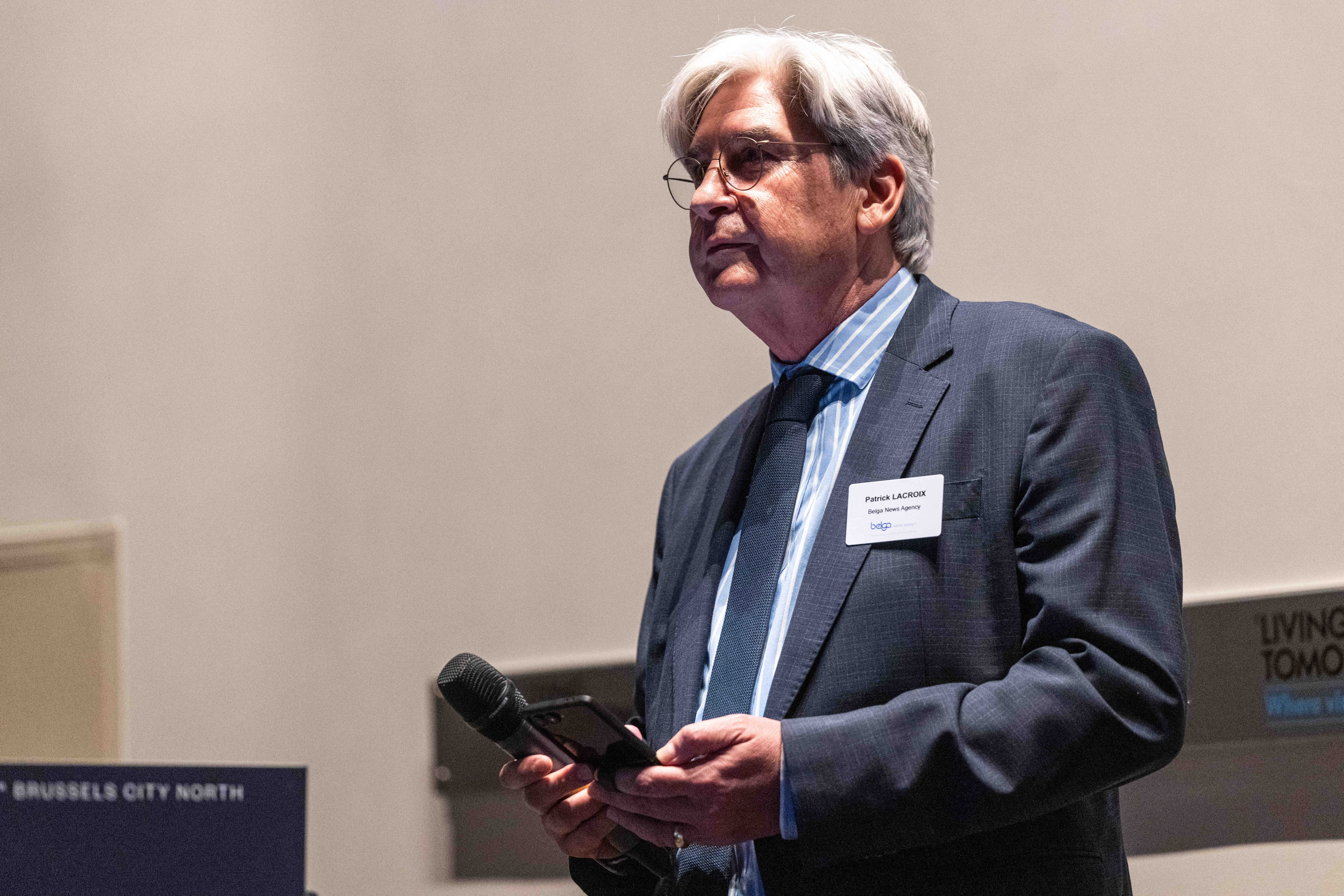
Patrick Lacroix, CEO of Belga News Agency, opens the evening at Living Tomorrow in Vilvoorde, 19 November 2026. Photo: BELGAIMAGE / Emile Windal
The evening opened with a fitting scene. At Lahbib’s request, the lights went out, and a room full of senior decision makers sat in the dark. The Commissioner wanted to make the moment of uncertainty tangible: what is happening, how serious is it, and who has a reliable answer?
From there she turned to a far more serious power cut.

Hadja Lahbib, European Commissioner for Preparedness, Crisis Management and Equality, during her keynote. Photo: BELGAIMAGE / Emile Windal
I. On the story that comes before the facts
A power cut in Spain and Portugal showed how quickly an explanation fills the space left by uncertainty.
1.1: A fake CNN article appears twenty minutes after the blackout
On 28 April 2025, at 12.33, the electricity grid of mainland Spain and Portugal failed completely after a series of generating units disconnected in southern Spain, according to ENTSO-E, the association of European grid operators. Trains stopped, communication was disrupted and tens of millions of people had to improvise. The scale of the incident was exceptional; so was the uncertainty about its cause.
Lahbib recalled how quickly unconfirmed explanations filled that gap. The claim that a Russian cyberattack lay behind the outage appeared on social media almost immediately, as did messages that attributed such a conclusion to the European Commission. The fact checkers of Maldita.es, in an analysis published by the European Digital Media Observatory, traced a fake CNN article in which Ursula von der Leyen blamed Russia; it was online by 12.56, some twenty minutes after the grid failed, and circulated in at least five languages.
European Council President António Costa said the same day that there was no indication of a cyberattack. The Spanish government’s report of 17 June 2025 found no evidence of a cyber incident after what it called the largest cybersecurity investigation ever carried out in the country, and the final report of the ENTSO-E expert panel pointed in March 2026 to a combination of technical factors in voltage control and the disconnection of power plants. The false stories needed twenty minutes; the official answers needed seven weeks and almost a year.
1.2: Lahbib gives leaders a sentence for the first hour
The incident illustrates a mechanism that returns in every major crisis. A technical problem acquires a social and psychological dimension. People try to understand what is happening, one explanation follows another, and speculation spreads while the responsible authorities are still investigating.
The Commissioner pointed to the responsibility of governments and companies to narrow that information gap quickly. Later in her talk she put it in one strong line: suspicion and doubt are the fuel of disinformation. Every silence and every incomplete statement can reinforce that process.
The task is demanding. Whoever communicates before the facts are sufficiently established risks spreading wrong information. Whoever waits for full certainty leaves the interpretation of the incident to others. Lahbib described the way out as a form of transparency: say what is known, say what is still being investigated, and say when the next update will follow.
In her own words: “Nous ne le savons pas encore.” We do not know yet. Sometimes, she said, that is the most credible sentence a leader can speak.
1.3: Equinor and Washington put the method into practice
Two cases from the week of the event show what this looks like in practice. When Equinor, the Norwegian energy group that the Frankfurter Allgemeine describes as Germany’s most important gas supplier, detected a cyberattack on part of its IT systems on 17 November, it published four updates in four days on one page. The attack was no virus and could not spread; it was still under way and it was too early to say how long recovery would take; finally, it had stopped, production had continued normally and there were no indications that data had been stolen or altered. Reuters confirmed on 20 November that the attack was over. Equinor named what it did not yet know, and one fixed place for updates made its communication verifiable for press and partners.
In Washington, a run of disruptions followed the Microsoft outage, including a failure in the communication network of air traffic control that led the FAA to halt flights nationwide and publish its own questions and answers page. On 18 November senior US intelligence and security officials told Congress that the incidents were unrelated and linked to patches and planned maintenance. Homeland Security Secretary Markwayne Mullin said he was “98 percent confident”, and FBI official Christopher Raia said that “as of right now” no malicious activity had been found, Politico reported. That is an American version of Lahbib’s sentence: a government speaking clearly while leaving room for what it cannot yet confirm.
For an organisation in crisis, this is a governance choice. It requires the willingness to make uncertainty visible while continuing to take responsibility for the information needs of others.
Reflections
How much uncertainty can a leader share in the first hour before people lose confidence in the message? What would a single page for updates require from an organisation that has never published one?
II. On a wider risk picture for Europe
Each country prepares for the risks it knows best; the next incident may come from elsewhere.
2.1: Recent weeks give the European risk picture concrete form
Lahbib placed that question in the context of European crisis preparedness. The risks for which countries prepare differ with their geography and experience. Spain, Portugal and France think first of wildfires and evacuations; this summer the fire near the Arcachon basin led to some 220,000 evacuations in the Gironde, and France activated the European civil protection mechanism, the BBC reported. Finland and Sweden live closer to the threat of Russian sabotage, cyberattacks and disruption of connections in the Baltic Sea. Elsewhere, floods, health crises or fragile transport chains are more pressing.
Recent weeks gave that picture concrete form. On 5 November a court in Helsinki sentenced the captain and a crew member of the Fitburg to prison for deliberately dragging the ship’s anchor across the seabed and damaging two telecom cables between Finland and Estonia, the first ruling in which a judge established intent. The EU’s maritime security report of 3 November mentions sanctions against almost 700 shadow fleet vessels and two Commission funded monitoring hubs for undersea cables. Off Romania and Bulgaria, drones struck at least seven merchant ships in October, according to Politico, the number Lahbib cited. On 14 November three more ships were hit near the Sulina canal, and by mid November The Insider counted at least thirteen. In a running crisis, every figure needs a date.
The next incident, however, will not necessarily come in the form for which a country or company is best prepared. In an integrated economy, a disruption far away can affect energy supply, transport, communication and supplies. The relevant risk is often a chain of events, and no single organisation controls its full course. The attacks on supermarket refrigeration showed this: after a first round in France in October, stores in seven other countries were hit three weeks later.
2.2: Brussels builds a joint risk assessment with the private sector
The European Commission is therefore working on a joint assessment of risks, threats and interdependencies. Lahbib linked that exercise to the Preparedness Union Strategy of March 2025. The aim is a higher level of readiness for the vital functions of society: water, food, health care, energy, transport, communication and payments.
Europe can develop shared threat assessments, prepare minimum requirements and recommendations, exchange experience between countries and organise cooperation with the private sector. That last point deserves particular attention, because companies operate a large share of critical infrastructure, logistics capacity and information services. A Belgian example appeared two days before the event: the Hasselt non profit Shield and KU Leuven are taking their cooperation model for cybersecurity in hospitals to European level with the CyberShield4Health project, which brings together 21 partners from five countries.
Lahbib gave an example from Sweden, where, according to her, thousands of companies take part in national resilience planning. They share information on the availability of stocks and the continuity of their supply chains, which helps the authorities prepare their response to disruptions of trade and transport.
2.3: Helsinki and a self sufficient school make preparedness part of daily life
In Helsinki she saw underground infrastructure that can serve as shelter in an emergency and is used in the meantime for sports, swimming pools and car parks. The facilities therefore remain operational, are maintained and form part of daily life.
Another example concerned a school that, she said, can function on its own for forty days, with its own energy supply and food stocks. Parents know their children are safe in such a scenario. Doctors, nurses, firefighters and other essential workers can then continue their public duties, because they need not all leave at the same moment to collect their children.
That is the core of preparedness: the capacity to absorb the first disruption, so that the organisation and its environment remain able to act. It requires investment, agreements and exercises long before any alarm sounds.
Reflections
Which risks does your organisation prepare for because they are familiar, and which because they are likely? How far should companies share information on stocks and supply chains with the authorities?
III. On the meaning of 72 hours
Three days of self reliance relieve the emergency services; the same logic applies to companies.
3.1: The Netherlands measures what a booklet can achieve
The period of 72 hours returned several times in Lahbib’s talk. European households are encouraged to be able to cope on their own for three days in an emergency, with water, food, medication, lighting, a radio and the means to stay in touch or to leave if necessary.
That preparation relieves the emergency services. In a large scale crisis they must be able to concentrate their scarce capacity on the people who need help immediately. Whoever can manage three days alone contributes to the resilience of the whole.
The Commissioner referred to the Dutch campaign Denk vooruit (Think ahead). Between late November 2025 and January 2026 every household received a booklet with practical instructions, and 91 percent say they received it. The share of Dutch people with an emergency kit rose from 30 percent in 2024 to 44 percent in 2026, and the number with an emergency plan doubled, the Dutch government reported. Public broadcaster NOS noted the other half of the figure: more than half of the population still has no kit. Reaching people and enabling them to act are two different results.
The communication challenge is at least as important as the practical one. A government wants to prepare citizens without provoking collective fear. The panic buying during the COVID-19 pandemic showed how disruptive behaviour becomes when people feel they are too late to protect themselves.
Preparation gives people a perspective for action. It makes them less dependent on improvisation, rumours and an uncertain search for instructions at the moment the infrastructure is already disrupted.
3.2: Lahbib asks companies for their own emergency kit
Lahbib then put the same question to the companies in the room. Does a business have its own emergency kit for the first 72 hours? Are alternative communication channels available when the corporate network fails? Can employees and suppliers be reached? Has it been agreed in advance who may approve a first message while the cause of the incident is still unknown?
Such questions usually receive less attention than technical protection against an attack. Yet they help determine whether a disruption remains manageable and whether the organisation can meet its responsibility towards customers, staff and other stakeholders. When the refrigeration of dozens of stores failed in the night of 2 November, the company had such a first message ready: the stores would stay open, with a temporarily smaller range of fresh and frozen products, AGF.nl reported.
Reflections
What would your organisation’s kit for the first 72 hours contain beyond technology? Who may approve a first public message while the cause of an incident is still unknown?
Hadja Lahbib in conversation with Laurent Winnock. Photo: BELGAIMAGE / Emile Windal
IV. On incident information as a board matter
European law sets deadlines for notification; the people affected keep their own timetable.
4.1: European law sets the clock for the first days
Lahbib then discussed NIS2, DORA, the GDPR, the DSA and the CSRD. Behind that series of acronyms lies a broad development: European regulation puts growing emphasis on risk management, demonstrable preparation for incidents and the timely availability of reliable information.
The obligations differ per legal framework. Under the NIS2 Directive, essential and important entities must in principle send an early warning of a significant cyber incident within 24 hours and a fuller incident notification within 72 hours. The DORA Regulation imposes specific reporting procedures for major ICT incidents in the financial sector: the initial notification is due within four hours of classifying an incident as major, and no later than 24 hours after the institution became aware of it. The GDPR in principle requires notification of a personal data breach to the supervisory authority within 72 hours and, in certain circumstances, information to the people affected.
The CSRD concerns transparency on, among other things, material risks in sustainability reporting. The DSA obliges very large online platforms to assess and mitigate systemic risks, including disinformation. These frameworks address other aspects of the problem, and they too raise expectations of governance and accountability.
The Commissioner drew a meaningful link between the deadlines for incident reporting and the 72 hours for which citizens are asked to prepare. The legal deadlines differ, but the parallel shows how critical the first days can be.
4.2: Maileva shows the distance between a notification and a warning
A notification to a regulator answers a specific legal obligation. The information needs of a customer, patient, traveller or citizen follow a different logic, and the two processes must connect. The first question is which actions the law requires; the second is who is affected by the incident and what information that person needs.
The case of Maileva, the La Poste subsidiary that sends letters and documents on behalf of companies, shows the distance between the two. On 14 November it announced that a cyberattack in mid September had exposed the names and postal addresses of 22 million recipients of its customers’ letters, with possible access to letters from the past ten years. Maileva had notified the French data protection authority CNIL and filed a complaint; by early November, several of its customers, including two social housing providers and the Hôpital Foch, had already warned their own people, franceinfo reported. L’Avenir carried the AFP report in Belgium. The people affected have no direct relationship with Maileva, which raises the question of who should inform them.
Here lies an important responsibility for the board. An organisation can file every prescribed form on time and still be too late with the information that helps people prevent harm.
Reflections
When a regulator and the public both need information, which deadline should set the pace inside the organisation? Who should inform people affected by an incident at a company they have never dealt with?
V. On a public that does not wait for the crisis unit
The panel turned to the moment an incident becomes public.
5.1: Ramacker reminds leaders who decides when a story breaks
The panel put that distinction into practice straight away. Benoît Ramacker, director of Risk & Crisis at safe.brussels and former head of communication at the National Crisis Centre, opened with a warning.
The panel, moderated by Laurent Winnock, with Benoît Ramacker (safe.brussels), Katrien Jansseune (FASFC), Raphaël De Beys (Proximus Ada) and Tom Samyn (Beltug). Photo: BELGAIMAGE / Emile Windal
“Ce n’est jamais vous qui allez décider quand ça va sortir. Jamais,” he said. It is never you who decides when it comes out. An organisation rarely controls the moment an incident becomes known.
Employees see what happens. Customers are affected. A supplier feels the consequences. Messages appear on social media or journalists start asking questions. The public conversation can begin while internal teams are still searching for the cause.
5.2: The European Commission learns its timing from Politico
The day of the event itself provided an example. On 19 November the European Commission confirmed that it had been the target of a cyberattack, after Politico had revealed the incident that morning. According to Le Soir, the attack had been detected on 22 October and confirmed on 26 October, and the attackers had misused ARTEX, an AI tool designed to detect vulnerabilities; L’Avenir described it as an AI assisted attack. The Commission had taken several applications offline as a precaution. Spokesperson Thomas Regnier said there was no evidence of a data breach affecting staff as a whole and that the investigation continued, Reuters reported, while VRT NWS quoted him saying the scale was difficult to assess for now.
Regnier also explained that some measures lose their effect once they become public. Staff quoted by La Libre spoke of “silence radio”, and a staff union said employees deserved answers. The same Commission that asks citizens to prepare received, on the same day, questions about its own incident communication. That combination makes Ramacker’s point concrete: the moment of disclosure was set by others.
5.3: Fleurus shows the cost of a week’s delay
Ramacker referred to the radioactive release at the Institute for Radioelements in Fleurus in August 2008. The release took place on Friday 22 August; the investigators needed time to assess its severity, and only on 29 August did the authorities advise residents of Fleurus and surrounding districts to avoid vegetables from their gardens and rainwater, according to the Belgian nuclear regulator FANC. Le Figaro wrote that residents heard it a week late, from the loudspeakers of police cars. The incident was rated level 3 on the international INES scale, as the French nuclear authority records, and Le Monde later described a series of failures in detection, response and communication.
The example shows why a legal or internal timetable cannot determine the need for communication on its own. The first question of residents was practical: could they still eat their vegetables? The consequences for the population, the degree of uncertainty and the questions that arise outside the organisation weigh at least as heavily.
5.4: Supermarket refrigeration becomes public through many channels at once
He also cited the cyberattacks on the refrigeration of European supermarkets. In the night of 1 to 2 November, attackers remotely switched supermarket cooling systems into defrost mode. Around forty Delhaize stores in Belgium and Luxembourg were hit, as well as stores in Sweden, Ireland, the Netherlands, Estonia and Finland, the BBC reported. Carrefour counted fifteen of its 700 Belgian outlets, according to NOS, and Colruyt Group five Spar stores, according to Reuters. One Proxy Delhaize in Hoepertingen spoke of at least 60,000 euros in lost food, VRT NWS reported.
The story reached the public through many channels at once. Delhaize store managers received a text message around four in the morning warning of sudden temperature rises (VRT NWS). That morning Delhaize spoke of an IT disruption, while Carrefour already confirmed a cyberattack (VRT NWS). A Ghent store owner wrote on Facebook that the shop had been hit by a cyberattack on its refrigeration (Het Nieuwsblad), and the CEO of the refrigeration installer Sabcobel confirmed the cyberattack to Belga (BBC). Customers saw empty shelves before there was an official explanation.
In a Swedish ICA store, temperatures reportedly reached 50 degrees. The store itself wrote so on Facebook, AP reported, while the ICA group only spoke of an incident in a limited number of stores, according to the Neue Zürcher Zeitung. That made the sabotage visible. Ramacker asked his audience to imagine the consequences if the temperature had been raised only a few degrees above the safe limit. Products could look normal while the cold chain had been broken.
5.5: Small temperature changes raise the larger question
That scenario remains a hypothesis, yet the coverage contains milder variants. In a Dutch frozen storage facility, the temperature one night stood at minus 10 instead of minus 20 degrees (NOS); at the Estonian chain Selver it rose two to three degrees before staff intervened within ten minutes (ERR News). Todd Gebski, whose company sells temperature monitoring, put it plainly in Food Safety Magazine: “If a case goes into defrost at 1 A.M. and recovers by 4 A.M., staff arriving at 6 A.M. will find product that looks and feels cold.” So far there are no publicly confirmed cases of illness linked to the attacks (AGF.nl). At the French blood service EFS, its own alarm systems detected the manipulation quickly (Tweakers). Whoever has an independent measuring point sees the incident first.
Here cybersecurity, food safety and public information meet. The visibility of a technical incident says little about the severity of its consequences. The board must decide on the basis of the real risks to people.
Ramacker’s practical advice was to look at the situation from outside the organisation as well: “Sortez de votre bulle.” Step out of your bubble. Listen to what people notice, which information they lack and which consequences they try to understand. For the supermarket customer the question was simple: is what is on the shelf still safe to buy?
The question then becomes more concrete. What information does the outside world need to act responsibly, even while the investigation into the cause continues?
Reflections
How can an organisation prepare a first statement for a moment chosen by others? Which measuring point outside your own systems would show you an incident first?
VI. On a recall as a communication decision
Food safety offers a tested model for informing consumers while facts are incomplete.
6.1: Jansseune explains when a risk leaves the company
Katrien Jansseune, communication director of the Federal Agency for the Safety of the Food Chain (FASFC), translated that principle into the procedures of food safety.
When contamination is suspected, the FASFC starts with a risk analysis and the tracing of the products involved. As soon as there is a risk for consumers, for example because a potentially unsafe product has already reached the market, it must quickly be decided who is informed and which action is needed.
The company has notification and information obligations. The FASFC can validate and support the communication about a recall. A product photo, recognisable identification details and a clear instruction are then essential. Consumers want to know whether they bought the product and what to do with it.
The supermarket case falls exactly on that boundary. The warmed products were still in the store. According to the FASFC, stores must measure temperatures through their own checks and withdraw products from sale when limits are exceeded or in case of doubt, VRT NWS reported. A public recall was therefore unnecessary, because the risk remained within the company. The public debate then turned to food waste, with Ghent University microbiologist Frank Devlieghere calling the rules too strict. A correct decision needs explaining as well.
6.2: The STEC outbreak shows how to name what remains uncertain
Jansseune referred to the STEC outbreak in Belgian nursing homes in August 2025. The FASFC counted infections in eleven nursing homes, more than seventy people ill and nine deaths; a later scientific analysis in Epidemiology and Infection arrived at ten deaths. Raw minced beef emerged as the most likely source, since all affected homes had served meat from the same batch. Because no samples of that batch remained, this could not be confirmed with absolute certainty, and the authorities said so openly. The FASFC, Sciensano, the national reference centre and the regional health administrations each contributed from their own competence, with joint updates published by, among others, the Flemish Department of Care.
6.3: The infant formula recall brings scattered warnings together
A second example was the recall of infant formula that began at the end of 2025 and was extended in 2026. Nestlé traced the contamination with the toxin cereulide to an oil blend containing arachidonic acid from an external supplier, according to its own timeline, and European food safety crisis coordinators identified the Chinese company Cabio Biotech as the supplier of the contaminated oil in all cases, according to the European Commission. Danone, Lactalis and smaller producers followed, Euronews reported. In Belgium, Danone recalled some thirty more lots of Nutrilon in consultation with the FASFC on 6 February (VRT NWS). At first the problem seemed limited to one product or one brand. As more data became available, it became clear that several producers shared the same vulnerability.
For the companies involved, this meant separate warnings and recalls. For consumers, it produced a complicated collection of notices. The FASFC chose to bring the information together on a single page, with batch numbers and best before dates, so that parents could check in one place which products were affected.
That is an essential aspect of incident reporting. A series of correct individual messages does not automatically add up to an understandable picture. The information must be organised so that citizens can use it. In the coverage of the refrigeration attacks there was no comparable central point of public information; the closest shared reference was the advice of the Centre for Cybersecurity Belgium, which was aimed at companies.
6.4: Distribution and relationships decide whether a warning arrives
These examples also show why broad, reliable distribution matters. A validated warning must reach the people who need to act on it. A national information infrastructure, multilingual channels and a working relationship with newsrooms increase the chance that official information becomes available in time and in a recognisable form. Journalistic follow up remains necessary afterwards, to test developments and place them in context.
Jansseune stressed that knowing each other and exercising together speed up cooperation. When several authorities, care institutions and companies are involved, their spokespeople and crisis managers must be able to find each other. A shared picture and aligned messages prevent citizens from receiving contradictory instructions.
A crisis shows how well those relationships were organised beforehand.
Reflections
When a correct decision provokes public criticism, how much explanation does it require? Who should organise a single point of public information when an incident crosses several sectors?
VII. On the digital incident in the boardroom
In the first phase of a cyber incident, facts and hypotheses circulate side by side.
7.1: De Beys asks management to separate facts from hypotheses
Raphaël De Beys, managing director of Proximus Ada, explained how a large technology organisation structures its incidents. Depending on the impact on customers, continuity, regulation and reputation, different escalation levels are activated.
In serious incidents, operational teams, a command centre and strategic management work together from their different responsibilities, with communication and legal expertise involved. Tabletop exercises help everyone know their role when the pressure rises.
De Beys emphasised the quality of the information presented to management. In the first phase of a cyber incident, hypotheses about the cause, the scale and possible further consequences often circulate. They must be kept apart from established facts.
“Le plus grand danger, c’est d’avoir des spéculations,” he warned. The greatest danger is speculation.
When a leader presents an unconfirmed technical hypothesis as certainty, trust can be damaged quickly. Later corrections make it difficult to present a coherent picture again.
7.2: Brussels and Paris handle attribution in different ways
The refrigeration attacks offered a Belgian example within days. On 12 November Interior Minister Bernard Quintin told Belga that the security services had indications of links with Iranian actors. Foreign Minister Maxime Prévot responded that the information did not suffice for an official attribution, and the federal prosecutor’s office could not confirm the statements, VRT NWS reported. Quintin maintained his position that evening, MR party president Georges-Louis Bouchez called for the expulsion of the Iranian ambassador, and Iran denied any involvement, according to De Standaard. Attribution is a governance decision with diplomatic consequences, and on the same day the same government gave two different signals.
France handled the question through formal channels. On 9 November the Paris prosecutor said the October attacks had been carried out “in the service of a foreign power, in this case Iran”, within a judicial investigation targeting three members of a unit linked to the Revolutionary Guard, CBS News reported; Reuters had reported the same day that French officials suspected Iran. That remains an accusation in an ongoing investigation, and Iran denies it (CNBC).
7.3: UZ Brussel and the Microsoft outage show what users need
Speculation arises within hours. When UZ Brussel and three connected hospitals suffered a network failure on 10 and 11 November, the hospital quickly communicated that there had been no cyberattack and no data breach (VRT NWS). Le Soir opened its report by noting that the failure was “ni la faute de l’Iran, ni celle de la Russie”. The denial had become part of the news.
Management therefore needs an overview of the confirmed facts, the impact on customers, the main risks, the actions under way and the decisions it must take itself. Technicians must be able to investigate and repair; management must control the consequences for the service.
One example made that difference clear. When a government digital service becomes temporarily unavailable, users mainly want to know whether they will miss an administrative deadline and which alternatives exist. A decision to extend a deadline can matter more to them than the full technical explanation of the failure. During the Microsoft outage, the Flemish bar associations wrote to the government, the High Council of Justice, notaries and bailiffs to have the outage treated as force majeure, because lawyers working with Outlook could not file their documents on time, RTBF reported.
The message that goes out must make the measure understandable. Communication then becomes an extension of the governance response.
Reflections
Which hypotheses should a board hear in the first hours, and which should stay with the technical teams? How should a government coordinate attribution when several ministers each hold part of the information?
VIII. On the chain of outside suppliers
Many incidents begin at a supplier the public has never heard of.
8.1: Microsoft shows the reach of a single provider
Tom Samyn, community manager at Beltug, the Belgian association of digital technology leaders, widened the perspective to the digital dependencies of companies. Among the IT decision makers of his community he sees a growing professionalism in incident response, and also a growing complexity.
The Microsoft 365 outage of 12 and 13 November was still fresh in everyone’s memory. Outlook, Teams and Copilot went down worldwide; governments from Japan to Norway reported disruption, and in Britain the NHS and pharmacies had problems. Microsoft ruled out malicious activity and apologised, AP reported, and on 16 November it traced the cause to a software bug from a July update in its network gateway servers, according to BleepingComputer. In Belgium, Computable wrote that the outage exposed a painful dependency, and De Tijd noted how much the modern economy relies on a handful of technology companies.
A failure at one technology provider can disrupt the communication and processes of organisations far apart at the same moment. Samyn saw it as an illustration of the dependency chains his members must manage.
8.2: Optimizely and N0n turn the third party into a standard frame
The same week produced two more examples. Researcher Scott Helme of Report URI found that 178 websites, including those of CNN, Zoom and the BBC, had served malicious scripts to their visitors through the marketing platform Optimizely; the code carried a valid Optimizely certificate, replaced crypto wallet addresses and intercepted card data, Ars Technica reported. Optimizely later said an unauthorised party had exploited a vulnerability in one of its products and that the problem was solved, according to RTL info, quoting Belga, which also mentioned Belgian sites among those affected. The 178 organisations had to inform their own visitors about a failure at a supplier that said little itself, while outside researchers set the pace of the coverage.
When the extortion group N0n claimed on 16 November to hold data on customers of JPMorgan Chase, Visa and Mastercard, all three pointed to service providers. JPMorgan said marketing data with names and email addresses had been accessed at vendors; Visa spoke of an incident at a provider in the Asia Pacific region, Mastercard of a limited number of email addresses at a third party. None of them named the supplier or the number of customers affected, SecurityWeek reported. The statement that an incident happened at a third party is becoming a standard frame. It limits reputational damage and leaves customers with an open question about responsibility.
8.3: Supermarket refrigeration shows the chain in physical form
Many organisations rely on cloud platforms, software vendors and outside service providers for their daily operations. An internal incident response plan must therefore also cover services over which the company has little direct control. The continuity of the organisation depends in part on the preparedness of its suppliers and partners.
The supermarket attacks show that chain in physical form. It had at least four links: the supermarket, the refrigeration installer, the manufacturer of the controller and the internet connection opened for remote maintenance. The attackers exploited management interfaces of controllers from manufacturers such as Danfoss, Dixell and Copeland that were directly reachable from the internet, the Centre for Cybersecurity Belgium found. Danfoss pointed to customers running outdated software (Euronews). The CCB advised companies to review their contracts and insurance terms with the refrigeration supplier before cutting the data connection, and to arrange secure access so that monitoring could continue (CCB). That is Samyn’s question in concrete form: who calls the store manager at four in the morning, and who may decide to cut the connection?
8.4: Samyn asks whom you will call tomorrow
Samyn also pointed to the lack of a shared picture of the situation. IT tries to repair the technical failure. Legal looks at obligations and possible liability. Communication watches over the information needs and the trust of the outside world. Operations tries to keep serving customers. Management must make choices.
When each team works only from its own responsibility, delays follow easily. The CEO must bring the relevant people together and ask what they know jointly, which consequences are certain and which decisions can be taken at once.
His closing advice was strikingly concrete. Tonight, think about whom you will call tomorrow when your website, your email or another essential service becomes unavailable. Then ask whether those people know each other, whether the arrangements have been rehearsed, and whether they can work together without the usual digital channels.
Reflections
How much responsibility can an organisation delegate to a supplier before customers stop accepting the explanation? Which of your contracts specifies who may cut a connection at four in the morning?
IX. On a seat at the decision table
Ramacker used a restaurant to describe the place of communication in governance.
9.1: The waiter belongs in the kitchen
The contributions of Samyn and De Beys connected with a point Ramacker had made earlier in the discussion: the place of communication in the governance of an organisation.
He used a restaurant as a comparison. When a dish is poor, the waiter receives the complaints, although he did not cook the food. The same happens when a communication officer must explain a decision that was taken elsewhere in the organisation.
A decision that seems defensible from an operational or legal point of view can be incomprehensible to customers and citizens. That perception must be taken into account before the decision is final.
“Le serveur doit être en cuisine,” Ramacker said. The waiter belongs in the kitchen.
The comparison is apt. A good communication officer knows the questions, expectations and concerns of the people outside the organisation, and that knowledge can help the board make better decisions. The CEO keeps the responsibility, with the relevant expertise around the table.
A crisis unit therefore needs a shared factual picture and the ability to reassess decisions as more information becomes available. Communication must follow that process, with consistent updates, recognisable responsibility and room to process new data correctly.
The difference between a well managed and a poorly managed incident often lies in that cooperation.
Reflections
At what stage should communication join a decision that is mainly operational or legal? How can a crisis unit revise a decision while keeping the confidence of the people it informs?
The audience at Living Tomorrow in Vilvoorde. Photo: BELGAIMAGE / Emile Windal
X. On an information chain that holds under pressure
Reliable information in a crisis depends on several parties, each with its own responsibility.
10.1: Several lines of information operate side by side
For Belga, the evening confirmed why incident governance concerns news organisations directly. During a crisis, several lines of information operate side by side. Companies and authorities issue official statements. Regulators receive legal notifications. Journalists check the facts and look for additional information. Citizens and customers try to understand the consequences for themselves. Leaders follow public reactions and must adjust their response as circumstances change.
A specialised information infrastructure can support these processes. Belga.share helps organisations make official information available; Belga’s network provides broad, multilingual distribution to the news media; Belga.press makes coverage, sources and history accessible to professional users and supports monitoring. The editorial teams bring their own expertise in verification, context and follow up.
10.2: The refrigeration case separates distribution from verification
The refrigeration attacks showed both roles at work. Several key messages in the case reached the public through Belga: the confirmation from Sabcobel, Quintin’s statement and Prévot’s written response, as L’Avenir reported. Belga therefore distributed both positions of the government, and its newsroom had to weigh them against each other. The distribution of an official message does not yet make it independently verified news.
Media also make decisions about timing. The BBC held back its report on a secret British operation to take thousands of vulnerable refrigeration controllers offline until the work was done (BBC). That operation was a precaution, and there is no confirmed attack on British controllers.
A news agency that works around the clock offers an additional advantage. An incident respects neither office hours nor the boundaries between language communities or sectors. Availability, established procedures, editorial experience and recognisable responsibilities help when speed and consistency are needed.
That infrastructure must remain transparent about the origin and status of information. An official statement remains the statement of the organisation concerned. Editorial coverage rests on independent verification and its own responsibility. The distinction gives both forms of information their place.
10.3: Monitoring helps organisations adjust after the first statement
Belga wants to develop that information chain further, including tools for monitoring and analysis. Reputation and trust can change after a first statement is published. An incident develops, facts are added, citizens ask new questions and misunderstandings can arise in the public debate. Organisations that notice those developments in time can adjust their information and their measures.
That makes the role of a news agency relevant to a much wider group than its traditional media clients. Reliable public information is a shared condition for crisis management, business continuity and responsible governance.
Reflections
How should official information be labelled so that readers recognise its status at once? When should a newsroom hold back a story at the request of the authorities, and who decides?
In the audience during the panel discussion. Photo: BELGAIMAGE / Emile Windal
XI. When the lights go out again
At the end of the evening, the different perspectives formed one picture.
Lahbib had shown how a European society can prepare for disruption: a common risk picture, essential stocks, cooperation agreements and warnings that give citizens something to hold on to. Jansseune brought the responsibility towards consumers into view. Ramacker stressed the need to take the information needs outside the organisation seriously. De Beys asked for discipline in separating facts from hypotheses. Samyn showed the digital dependencies that make even well prepared companies vulnerable.
What connects these insights is a shared understanding of responsibility. Technical knowledge, legal obligations, governance decisions and public information must be available at the same moment to the people who have to act on them.
That becomes more important now that incidents affect several sectors and countries at once. A failure at a cloud provider can affect the services of a hospital. A cyberattack on a refrigeration controller can become a food safety risk. A power cut can, within minutes, give rise to rumours that deepen the uncertainty.
An organisation can prepare for its own actions. It can also decide in advance how it will communicate with other responsible parties, authorities, media and citizens when the facts are still incomplete.
That requires the discipline to speak in time, the courage to acknowledge uncertainty, and the willingness to let independent parties check the information.
When the lights will go out again, we do not know. Who will then provide reliable information is something we can organise today.
AI tools assisted with research and drafting. Patrick Lacroix retains full editorial responsibility.