

The Terms of the Handshake
AI, Chinese News Media and the Choices Facing Europe
Patrick Lacroix | Cyber Territories
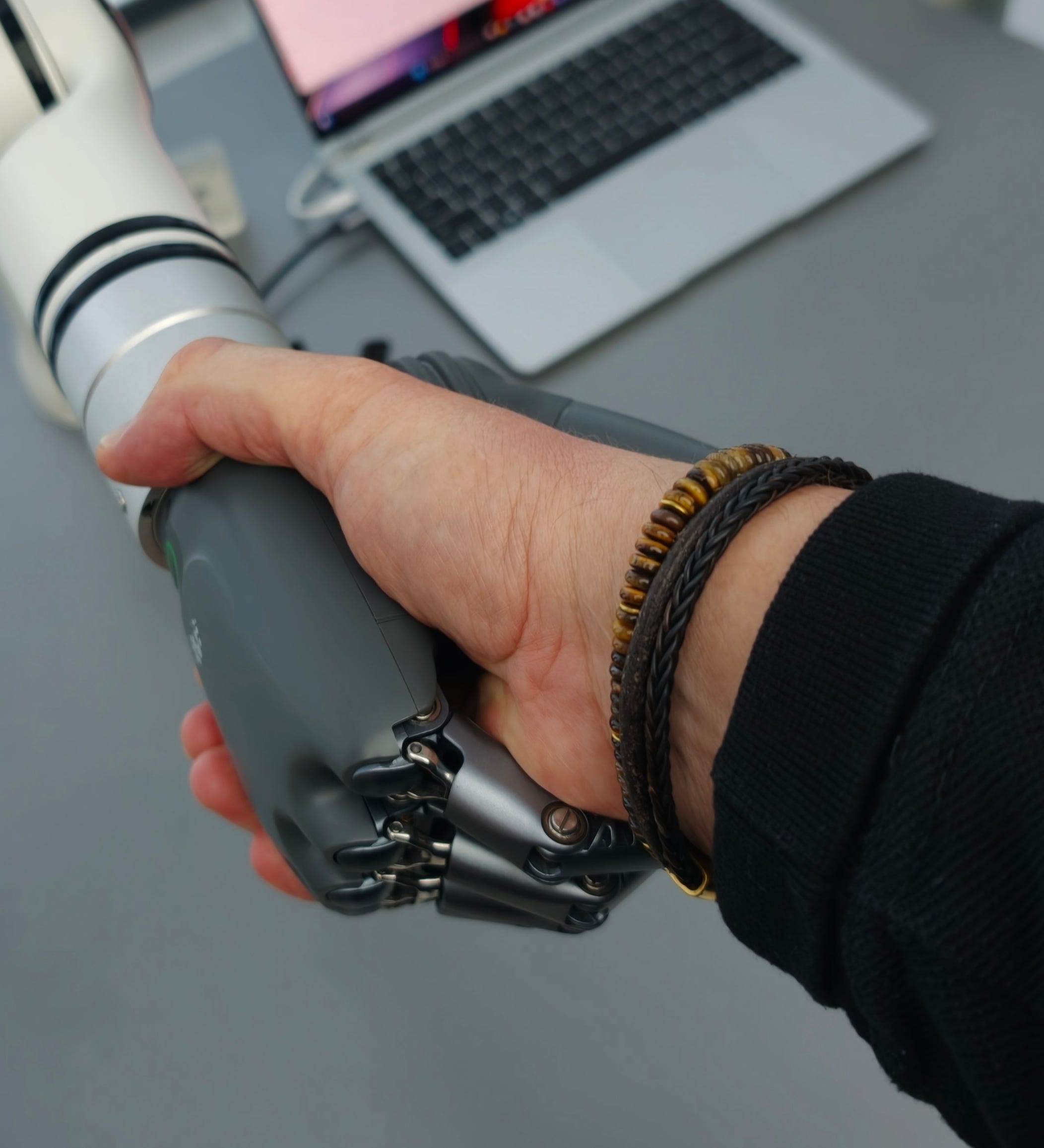
A handshake at BrainCo. Photograph by Patrick Lacroix.
At BrainCo, I photographed a handshake with a robotic hand. Looking at that image after eight days in China, I find it a useful starting point for thinking about the relationship we are developing with artificial intelligence.
The visit was an innovation mission organised by Living Tomorrow, in the company of CEOs from diverse sectors. Our programme in Beijing, Hangzhou and Shanghai included the Institute for AI Industry Research at Tsinghua University and Alibaba in Hangzhou. Alongside these visits, I used Chinese AI models, news services and social applications extensively. What impressed me most was the competence with which technology had been incorporated into ordinary activities, and the confidence of the people building and using it.
WeChat and Alipay were part of my daily experience. Facial recognition seemed to appear wherever an interaction could be made faster. Younger people and older people alike often seemed entirely comfortable with arrangements that require explanation or assistance in many European settings. Convenience was immediate; the implications for privacy were harder to assess.
I also felt a consistent presence of rules, expectations and boundaries. The people we met generally expressed pride in their achievements with a restraint that I appreciated. There seemed little need to persuade a visitor that their approach was correct. The expectation was that its results would be persuasive enough.
My professional experience kept bringing me back to a practical question. How does this combination of technological capability, integrated services and political direction affect the institutions that produce and distribute news? To explore that question, I examined published reporting, academic research and the media organisations’ own documentation. I write here in a personal capacity, with the concerns of our profession very much in mind.
Our discussion of AI often starts with the newsroom task: transcription, translation, an initial draft, an automated summary. I wanted to understand the broader organisational choices. An archive can become a research service. A news application can answer questions. A publisher can help a reader understand a local decision and identify the next practical step. Each possibility changes the relationship between journalism and its users.
That is the question I brought home: how is AI changing the role of Chinese news media, from producing journalism to organising access to information and services, and what can European news agencies and publishers learn while preserving editorial independence? It requires us to consider capability, ownership, responsibility and the continuing cost of finding out what happened.
News inside the system
China’s institutional arrangements determine who can produce news, who can distribute it and which obligations accompany those activities. The country’s internet news provisions distinguish licences for original reporting and publication, republication, and distribution platforms, with news defined broadly around public affairs. This distinction helps explain the relationships between media organisations and technology companies.
Eligibility for an original reporting licence is restricted to news organisations, entities they control, or entities supervised by news and propaganda authorities, while the same provisions limit foreign participation and the involvement of non-public capital in editorial newsgathering through Articles 6 to 8. These arrangements give established news institutions a recognised position within the information system. They also make the conditions of their authority different from those of an independent European newsroom.
The relevant comparison is therefore between several kinds of power. A news organisation may have the authority and professional resources to produce reporting. A platform may organise the interface through which the reporting is encountered. A public authority may determine the conditions under which both operate. The allocation of these powers matters as much as the technical capabilities of any individual model.
The formal obligations extend into recommendation. China’s algorithm rules require mainstream value orientation and controls on news sources, alongside human intervention mechanisms and user options to turn off personalised recommendations. Political direction, commercial optimisation and certain user protections are thus part of the same regulatory framework. Whether a particular service implements those protections effectively remains a separate question.
Within this framework, organisations differ considerably. Xinhua’s Yudian service addresses institutional information and political learning, while Sichuan Daily’s Chuanguan combines a provincial news application with an information corpus and newsroom systems. At the local level, Banyuetan has described county media centres struggling to retain staff, finance operations and maintain a useful relationship with residents. A demonstration by a major institution tells us little about the resources available to every local newsroom.
It is equally important to recognise professional judgement within the system. In Joanne Kuai’s account of her research on Chinese journalism, journalists use AI to improve efficiency and reduce political risk, while some also investigate technological harms and alert the public to new problems. Her description makes room for professional aspirations, institutional loyalty and practical negotiation. Those activities can coexist within the same newsroom.
For a European reader, this requires some care. The ability to investigate a consumer problem or criticise a harmful application tells us something meaningful about professional practice. It gives us much less information about the freedom to challenge the political institutions that define the permissible scope of journalism. Both questions deserve attention on their own terms.
Organisational reform also precedes some of the most visible AI products. According to Xinmin Evening News’s account of Shangguan’s development, the applications of Jiefang Daily, Wenhui and Xinmin Evening News were combined in January 2025, establishing shared technical foundations and editorial arrangements before a subsequent conversational redesign. Consolidating systems, preparing archives and organising common services may be less photogenic than a synthetic presenter. They can be essential to making an AI application useful.
This is the first point I would retain for our sector. An organisation’s ability to integrate technology depends on its mandates, data, working methods and decision rights. Buying a model gives access to a capability. Making that capability part of a dependable news service requires choices across the institution.
Where the audience already lives
During my stay, the convenience of integrated applications was often more striking than any individual feature. The experience encouraged me to think about news as one activity within a person’s day, alongside communication, payments, practical questions and entertainment. A publisher competes for a useful place in that day, even when the journalism itself has substantial public value.
The 2025 China Spektrum report from MERICS and the University of Trier maps distinct environments for social interaction, entertainment, knowledge exchange and news. Its platform descriptions distinguish WeChat’s public accounts and social relationships, the short videos of Douyin and Kuaishou, Bilibili’s video communities, and Weibo’s publicly visible discussion. Distribution strategy must account for the activity that brought the user to each setting.
The same report places Xiaohongshu around lifestyle and product reviews, and Zhihu around in-depth questions and expert contributions. A publisher needs to understand the user’s purpose before choosing a format.
A short video encountered between entertainment items has a different editorial task from an article deliberately opened in a news application. Each format needs to preserve enough evidence and context to remain useful when separated from the publisher’s usual presentation.
There is evidence that the characteristics of news matter within these environments. In a 2025 study of 92,895 news-related Douyin videos from 2,663 verified news outlets, Jinhui Li and Wen Shi found associations between engagement and factors including prominence, uniqueness, sentiment and the government’s agenda. Their findings concern engagement. They give us a reason to investigate how a format attracts attention, while leaving comprehension and lasting trust to be measured separately.
For Gen Z, the challenge is equally concrete: what does a young reader need to understand, and which explanation is worth completing? Treating an entire generation as a preference for shorter content avoids the harder work of understanding differences in motivation and knowledge.
The older users I observed also encouraged me to question familiar assumptions about digital adoption. Yet CNNIC’s figures for the end of 2025 put internet use among people aged 60 and over at 53.7%, compared with overall internet penetration of 80.1%. The people most visible in connected urban environments can make adoption appear more universal than it is. An interface that works well for confident users still needs to be assessed for everyone else.
Conversational AI adds another set of expectations. In its 2026 report release, CNNIC estimated more than 700 million generative AI users by the first half of the year, with question answering cited by 76% of users. These broad measures cover far more than news. They nevertheless make question answering an important interface for media organisations to examine.
The question itself may be more useful than a conventional content category. A resident wants to understand whether a municipal decision affects a particular neighbourhood. A parent wants to distinguish a verified health recommendation from a popular claim. A professional needs to know what changed in a policy and which document confirms it. A well-designed news service could connect each need to reporting, context and a visible source.
There is also room for human presence within an AI-intensive product. In its account published on 2 August 2026, The Paper described a redesigned application combining a conversational entry point, selected editorial content and podcasts with human presenters. Readers may appreciate automated assistance while still choosing to listen to people whose judgement they recognise.
For publishers, the opportunity is to make professional journalism easier to use in the form a situation requires. A short explanation, a full investigation, an audio briefing and an interactive question can serve different purposes within the same relationship. The editorial objective should remain clear across them: help the user understand something sufficiently well to make a better judgement.
Audience value requires several measures. Views, completion and return visits offer different indications; understanding, remembered attribution and willingness to pay need their own tests. Management has to decide which outcomes justify the additional work.
AI at work in the newsroom
Among the innovative Chinese newsroom projects, Chuanguan is useful because it connects several operational needs. In February 2025, Sichuan Daily announced DeepSeek-R1’s integration into its news application, its Ruoshui provincial information corpus and its intelligent media production platform. One model capability was being applied across a connected editorial and information service.
The publisher’s description includes news questions with traceable sources, structured summaries, corpus processing, knowledge graphs and assistance within editorial systems. A corpus is simply an organised collection of material that a system can use; a knowledge graph records relationships between entities such as people, places, organisations and events. Their value depends on the quality of the underlying records and the accuracy of those relationships.
An especially relevant detail is the explicit retention of professional human calibration for PDFs, tables and numerical accuracy. Anyone considering a news archive as an AI resource should pay attention to that work. An old document may contain the right information while presenting it in a form that a machine interprets incorrectly. A misplaced column heading or an ambiguous date can produce a fluent answer with a serious factual error.
The implications extend into the newsroom budget. Data preparation, verification and maintenance need owners and time. If a system is evaluated only on how quickly it produces a draft, the organisation may miss the effort required to check that draft, investigate uncertain references and correct the archive from which it was produced. The relevant unit of efficiency is an accepted, reliable piece of work.
Visible publication offers another kind of evidence. By April 2025, China Media Project had counted 36 AI-assisted front pages at Southern Metropolis Daily, approximately 35% of the year’s total at that point. The same analysis noted the continuing use of documentary photography and the absence of those synthetic covers during the annual Two Sessions political meetings. This was a selective editorial practice, with choices about subjects and occasions.
Such examples force a useful distinction between illustration and evidence. A generated image may help explain an abstract policy, represent a possible future or accompany commentary. A photograph offered as a record of an event carries a different claim. Readers should be able to recognise which claim the publication is making without needing technical expertise.
The distinction becomes more difficult when a real story is reconstructed. In July 2026, UNESCO Courier described an AI-generated film revisiting the story of Chen Yurong, the mother whose sustained walking and diet had enabled her to donate part of her liver to her son. The original reporting dated from 2009, and the new production used synthetic imagery to present that account to a younger audience. Its appeal raises legitimate possibilities for making archives accessible.
A reconstruction, however, inevitably involves decisions about what the scene looked like, how time is compressed and which details are supplied. Those decisions can add emotional meaning beyond the documented record. The newsroom should identify them as editorial choices and ensure that an invented visual detail never becomes apparent evidence of something that happened.
The same UNESCO feature describes Xinhua’s digital anchor experiments and quotes practitioners who distinguish scripted presentation from reporting, source relationships and editorial judgement. Synthetic presentation can be valuable where a verified script needs to be delivered in additional formats. The managerial question is what the newsroom then does with the time and capacity released.
It would be reasonable to expect more original reporting, better verification or improved accessibility. Each outcome requires a deliberate allocation decision. If the immediate consequence is simply a higher volume of material, the organisation may improve a production statistic without strengthening the service for which readers or clients are prepared to pay.
Human review itself needs a clear definition. Kuai’s research describes AI being used to identify politically sensitive figures or terms, alongside more familiar tasks such as transcription and archive organisation. A review process can check facts, language, rights, privacy, institutional policy or political acceptability. Calling all of this “human oversight” leaves too much unexplained.
For our organisations, the useful discipline is to identify each check’s purpose and who can decide. An editor needs the evidence behind a suggested correction and the authority to reject it. Training should equip staff to make these decisions within their actual work.
When news becomes an answer
Once reporting and archives can be retrieved reliably, a news organisation has additional product choices. It can help a user research an issue, assemble a briefing, compare documents or monitor a developing subject. The final article remains valuable, while the knowledge required to produce it can support services with different users and forms of payment.
Xinhua’s published descriptions of Yudian make that ambition unusually explicit. At its June 2026 launch, Xinhua described seven functions covering political theory learning, source tracing, news recommendation, news questions, verification, issue analysis and drafting. Together, those functions describe a professional information environment organised around tasks.
The product documentation identifies party and government institutions, research bodies, universities and state-owned enterprises among its intended users. Access is offered to invited institutions, with annual subscriptions and additional knowledge-base services set out in its account and purchasing information. This is a defined institutional proposition with a procurement process, rather than a general indication of consumer demand.
Users are told they can combine platform information with personal and institutional documents, ask questions about them, prepare drafts and inspect original references through Yudian’s knowledge-base and source-checking functions. The product also retains human finalisation of documents. The interesting combination is current reporting, accumulated knowledge and a customer’s recurring professional need.
Its political purpose is equally clear. Reuters reported Yudian’s intended role in promoting Xi Jinping’s thinking, and the service’s own description places political learning and mainstream values at the centre of its identity. These are essential elements of the product. They shape both the information selected and the institutional meaning of an authoritative answer.
A European agency can recognise the functional opportunity while choosing a different editorial basis. A customer might want a briefing supported by documented reporting and clear distinctions between established facts, attributed claims and unresolved questions. The service would need to preserve those distinctions as information is selected and summarised. Its authority would depend on the quality and accountability of the reporting process.
Shangguan offers a related proposition for a wider set of daily activities. In its September 2026 redesign, the application organised its main interface around news, quick questions and services. According to Xinmin Evening News, it combined more than 40 service functions across ten domains. The interface asks whether a news organisation can be useful at the moment a reader needs to understand something or complete a practical task.
Its Trust Hub is described as a knowledge base connected to content review, value alignment and answer production in the group’s account of the system. That same September report says its Kuaiwen assistant had joined Huawei’s Xiaoyi platform, with a Qwen connection still forthcoming. The wording matters: a reported integration, a planned connection and a mature external business represent different stages of development.
For a reader unfamiliar with agentic AI, three activities should be distinguished. A conversational system answers a question. A more elaborate workflow can retrieve several documents, compare them and prepare an output for review. A system authorised to act might also submit a form, make a booking or change an account. Each additional permission creates responsibilities for authentication, consent and error handling.
Consider a hypothetical local news service explaining a change in municipal parking rules. Retrieving the decision and answering a resident’s question requires accurate information and an appropriate account of uncertainty. Applying for a permit on the resident’s behalf additionally requires authority to use personal information and confirmation of the action. The same interface can conceal very different levels of consequence.
There are also commercial limits to integration. In October, Sixth Tone reported that more than 150 applications had refused Doubao’s graphical interface automation on Nubia’s agentic smartphone, including major communication, payment and other services. The applications remained available for manual use. The restriction concerned how an assistant could operate them on a user’s behalf.
The report identified privacy, security and protection of competing commercial systems as possible explanations, attributed to a Tsinghua researcher. These are familiar issues for any company considering access by an external agent. Technical ability to perform an action does not settle the right to perform it.
For news organisations, the strategic concern is the ownership of the relationship. If another company’s assistant selects the material, produces the answer and completes the action, the original publisher may become less visible to the user. A source link, an identifiable editorial contribution and contractual conditions for access each address part of that problem. None should be assumed simply because the underlying content is valuable.
An agency or publisher developing its own service must make corresponding commitments. Users should be able to inspect a supporting source, distinguish current information from an older answer, and understand who will correct a mistake. A product that becomes more useful through integration also needs a more precise account of its limits.
Who defines a trustworthy answer?
“Trust” is an attractive product description because it can refer to several desirable qualities at once. A source may be identifiable. A statement may be factually correct. A newsroom may be independent. A response may satisfy an institution’s rules. A user may feel confident. These qualities need to be assessed separately.
Yudian’s promise of traceable answers is explicitly combined with political learning and value orientation. Shangguan’s description of Trust Hub similarly combines an authoritative knowledge collection with content review and value alignment. The resulting question is precise: which part of trust does a particular mechanism establish?
A correct reference can establish that an institution said something. It may leave open whether the institution’s account is complete, whether another credible source disagrees, or whether the underlying claim has been independently verified. Good journalism records those differences. An answer system needs a way to retain them when compressing several documents into a few sentences.
This distinction also applies to synthetic content. China’s labelling measures, effective from September 2025, allocate responsibilities to service providers, distribution platforms, app stores and users. They provide for visible indications and information embedded in file metadata through a set of explicit and implicit labelling requirements. The design takes the involvement of several actors seriously.
The rules distinguish generating content from publishing it. Article 9 permits providers to supply output without an explicit label under specified conditions, including user obligations and retention of relevant logs for at least six months. Article 10 requires users publishing generated or synthetic content through online dissemination services to declare it proactively and use the provider’s labelling function. Permission to obtain an unlabelled output therefore leaves a separate obligation when distributing it publicly.
Implementation presents familiar difficulties. In a June 2026 analysis for Oxford China Policy Lab, Zilan Qian described unlabeled AI videos, human work incorrectly identified as synthetic, watermark-removal services and differences in providers’ commercial incentives. A comprehensive rule can still produce uneven results. Enforcement, technical performance and the ability to contest a mistaken label all require attention.
For a newsroom, provenance and verification consequently remain separate tasks. A genuine photograph can be given a false location or date. A clearly labelled synthetic diagram can explain an established fact accurately. A detector’s output is a reason to investigate; the conclusion still requires an assessment of the material and the claim attached to it.
Public criticism of synthetic personalities offers another useful distinction. China Media Project described the controversy around AI influencer Fang Taozi after a contact-lens promotion claimed personal experience of wearing the product. The account records criticism in Chinese media and the reported removal of the promotion. A disclosed artificial personality can still make a deceptive claim about physical experience.
That is relevant to journalism as well as advertising. A synthetic presenter can deliver a verified script under a newsroom’s responsibility. It should never imply that it witnessed an event, interviewed a source or experienced a condition. These are claims about how knowledge was obtained, and they remain meaningful regardless of how convincing the presentation becomes.
China’s governance framework also includes purposes beyond protection against deception. Its algorithm and generative AI rules combine information obligations with explicit political requirements, while China Media Project’s analysis of China Daily’s AI strategy describes an ambition to shape international narratives. An effective mechanism for enforcing policy can therefore require a separate assessment of its implications for public scrutiny.
Europe faces its own choices about accountable publishing. Under the AI Act’s transparency framework, public-interest text can qualify for an exception to the deployer’s disclosure obligation where there is substantive human review or editorial control and an accountable publisher. The Commission’s guidance explicitly distinguishes that review from superficial spelling or grammar checks. Editorial responsibility has to describe real work and actual authority over publication.
For me, the essential standard is whether an answer can be questioned effectively. Can the user see what supports it? Can a credible alternative account be considered? Can an error be corrected in a way that reaches the people affected? Confidence becomes more justified when these procedures are available and understandable.
Who owns the value?
The technical possibility of answering a question leaves a commercial question unresolved. Someone has to pay for reporting, prepare the material for reuse, maintain the service and handle mistakes. The value created by a useful answer may be shared among several organisations, with very different bargaining positions.
Yudian’s annual institutional subscriptions and additional knowledge-base services illustrate one approach: sell access to a defined professional service. A public procurement record makes the proposition concrete. On 29 June 2026, Shanxi Normal University announced a 98,000-yuan award to Xinhuanet for Yudian’s standard service, with the procurement notice specifying a one-year term from 1 July 2026 to 30 June 2027. This establishes a named institutional customer and an awarded price, while leaving total revenue and profitability open.
People.cn’s media-corpus service platform, announced in May 2026, illustrates another proposition, combining data preparation, standards, security and rights management. These services involve more than granting access to an undifferentiated archive. Their practical value depends on making the material usable for a defined purpose.
The work described in the People.cn announcement includes cleaning, annotation, processing and collaboration with infrastructure and research partners. Such activities give usable form to material that already exists. They also create continuing costs and contractual responsibilities. An organisation assessing an AI data business needs to know who performs them, who pays for them and what rights the service actually supplies.
The Paper is pursuing a different set of adjacencies. In a report published on 2 August 2026, it described AI workbenches for creators, small-business brand operations and microdrama production. These may create customers beyond the conventional news audience. They also require a publisher to explain the separation between journalism, promotional work and other commercial services.
The next tests are customer use, renewal, delivery costs and the effect on the editorial operation. A documented procurement helps establish demand; a sustainable business requires those further measures.
Local experience provides an important qualification. In February 2026, Banyuetan reported county media centres facing staffing burdens, weak advertising, difficulty retaining skilled people and limited audience response. The same reporting described attempts to earn income from public-service and other activities, sometimes with substantial operational complications. Formal integration and an institutional mandate offer limited reassurance if residents find little reason to use the service.
There was a more encouraging detail in that account. A livestream with an agricultural expert attracted local interest because it helped farmers address a practical problem. It is a useful reminder that relevance can be specific and ordinary. The information service succeeds when it understands the problem well enough to bring credible knowledge to it.
Copyright adds a second set of conditions to commercial feasibility. China’s 2023 generative AI measures require lawfully sourced data and respect for intellectual property. Those requirements need to be applied to particular works, uses and participants. They do not establish an exclusive market in which technology companies must purchase all legitimate training material from state news organisations.
In September 2026, the Supreme People’s Court explained that its new guidance left the copyrightability of AI-generated content and the classification of unauthorised model training unresolved because substantial disagreement remained. This is a significant qualification to any assumption that China has already decided the central copyright questions. The legal system is still working through the relationship between innovation, human contribution and protected interests.
The same explanation describes responsibility for infringing outputs in terms of control, duties of care, the parties’ roles, training-data contributions, precautions and benefits. It also addresses evidence that developers may need to provide about training sources and processes. Responsibility is differentiated; neither the presence of a user prompt nor the label of technology provider settles it automatically.
Licensing initiatives are developing alongside these disputes. In May, China News Service reported a corpus initiative involving 22 organisations and a declared principle of obtaining authorisation before use. The same report described unauthorised scraping and difficult rights clearance as continuing problems. The initiative expresses a practical effort to organise permissions, with its results still to be established.
This combination of litigation, rules and negotiated access is recognisable from a European perspective. Courts help determine the legal boundaries. Licensing negotiations establish workable commercial terms within those boundaries. Product development establishes whether the authorised use creates enough value for a sustainable service. Each part is necessary, and none guarantees the others.
Our own legal framework requires similar precision. The EU Copyright in the Digital Single Market Directive distinguishes the scientific-research text and data mining exception from the broader exception subject to appropriate rights reservations. Its press-publication provisions recognise qualifying publications by news agencies while excluding mere facts and specifying other limits. The commercial argument should therefore explain the value of reporting, selection, context, service and authorised access without claiming ownership of reality.
For practical negotiations, I would distinguish the activities before discussing a price. Training and fine-tuning use material to adjust a model’s parameters. Retrieval supplies selected material to a system when it prepares an answer. Display, publication and redistribution determine what other people subsequently receive. A proposed licence should identify the activities it covers and the rights needed for each of them.
These choices also affect the service being purchased. A historical collection might be useful for one training exercise, while a current news service requires continuing publication, reliable updates and corrections. An internal research tool and a public answer product create different relationships with the originating publisher. Treating all of these uses as a single category makes both valuation and accountability unnecessarily difficult.
Transparency can help identify the relevant parties and materials. The European Commission’s guidance distinguishes the AI Act’s obligation to publish a summary of training content from its obligation to maintain a copyright compliance policy. A disclosure document is evidence to examine. Permission, any applicable legal exception and the terms of a commercial agreement require their own assessment.
People’s identities also require attention. China Newsweek’s reporting on likeness licensing described modest offers for extended use and concerns about scope and control, while CCTV examined the risks behind promises of easy income from licensing a face. A newsroom using synthetic versions of presenters or contributors should consider duration, permitted contexts, consent, remuneration and the consequences of ending the relationship.
For agencies, a durable commercial model must account for the fixed cost of maintaining reporting capacity. A verified report costs money to produce before the number of eventual questions, summaries or uses is known. Access to a defined collection or service can reflect that continuing commitment. Counting individual requests may help manage capacity, but it should never replace an understanding of what must be financed.
What Europe should build
My strongest impression from China is the seriousness with which integrated use is being pursued. The combination of archives, editorial systems and public interfaces at Chuanguan, and the news-and-service proposition at Shangguan, deserve a considered response from European media. We should evaluate the functions they make possible and establish our own conditions for using them.
News agencies have a particular role: making their reporting usable by clients across formats, languages and products. AI services extend this role into customers’ automated workflows. The agency needs to determine what it supplies, under which rights and with which editorial commitments.
Reuters provides a concrete comparison. On 8 July 2026, it launched a Model Context Protocol server enabling customers’ AI agents to search, retrieve and download the Reuters content covered by their subscriptions. Its announcement described uses including selecting visual assets for drafts, assembling multimedia material and curating news for particular audiences. The commercial relationship remains attached to licensed access, while the content becomes usable within the customer’s AI workflow.
In the Reuters implementation, MCP provides the connection through which an agent can request subscribed material. For an agency designing such a product, retrieval, generated summaries and editorial analysis should have identifiable status. Clients need to know which outputs carry the agency’s editorial endorsement and which require their own assessment.
Correction is especially important. Once a report has been incorporated into a generated answer, replacing the original article may be insufficient. A service should be able to identify the corrected version, tell clients what changed and support an update of affected products. The capacity to correct is part of the value of an accountable information provider.
Rights information should be equally operational. A client needs to know whether access permits internal research, publication, translation, model training or another defined use. A contributor’s image or voice may carry restrictions distinct from those attached to the text. Clear metadata and contracts can make these differences manageable before they become disputes.
Multilingual services deserve a place in this work. An agency could support questions in several languages while preserving a report’s references, attributed claims and qualifications. Testing should cover names, figures, legal terminology and quotations. Smaller language markets could pool development and evaluation costs while retaining editorial authority, making services feasible that each participant would struggle to maintain alone.
For publishers and public broadcasters, the direct audience relationship introduces another priority. An assistant should help a person understand an issue or accomplish a worthwhile information task. Its usefulness can be assessed through comprehension, return use, willingness to support the service and the quality of the resulting relationship. A conversation that produces more interactions without improving understanding offers a weak reason for continued investment.
A local publisher might begin with one subject for which it has accumulated reporting and knowledge: housing, municipal decisions, transport or education. It could test whether a reader can ask a practical question, see the relevant evidence and understand what remains uncertain. That is a manageable product proposition with a clearer editorial purpose than a promise to answer anything.
Service journalism also needs institutional safeguards. A newsroom helping residents navigate a public service must retain the ability to investigate that service. Commercial relationships with local businesses need the same separation. Convenience should add value to the reader’s relationship with the publication while preserving the newsroom’s freedom to ask questions that a partner would prefer to avoid.
Privacy deserves the same attention as editorial accuracy. A question about debt, health or immigration may reveal much more about a reader than opening a general news article. I would want a service to explain which information it retains, who can access it and whether it is used for another purpose. A reader should be able to obtain useful assistance without being pressed into unnecessary disclosure.
For an assistant authorised to act, permissions should be specific and reversible. Preparing a form, sending it and making a payment are separate decisions with different consequences. A product could ask for confirmation at the relevant point, retain an intelligible record and provide a practical way to resolve an error. These provisions belong in the initial design and budget.
Cooperation can make this work more realistic. Local_Vocal and DRIVE local describe collaboration among publishers, dpa and the German Research Center for Artificial Intelligence around AI and local information services. Shared research, technical testing and infrastructure can reduce duplicated effort. Editorial organisations can maintain distinct identities while agreeing on practical standards for rights, evidence and correction.
The same logic applies to evaluation. Agencies and publishers could use common tests for numerical accuracy, source fidelity, translation, outdated information and inappropriate certainty. Sharing how a system fails can be as valuable as sharing a successful demonstration. Procurement becomes more informed when organisations can compare complete workflows under conditions resembling real work.
Evaluation must include the people using the tools. Management should measure the full cost of producing accepted work, including review and correction. Staff need authority to stop an unreliable process without being treated as opponents of innovation.
Editorial boundaries can be explicit and supportive of experimentation. dpa’s June 2026 rules encourage assistive AI, require human verification of derived editorial formats and set strict limits on synthetic photographs and videos in news services. Such rules give teams a defined basis for trying new methods. Their value depends on whether the organisation supplies the training, time and technical support necessary to apply them.
The test I would bring to any investment is straightforward. Does it improve access to reliable reporting, make a useful service possible or allow more editorial resources to be devoted to original work? Can the organisation explain its costs, its rights and its responsibilities? And can it demonstrate the improvement to clients, readers and its own staff?
European independence should be expressed through these practical arrangements. Users should be able to inspect evidence, encounter legitimate disagreement and obtain a correction. Publishers should be able to change suppliers and understand what happens to their data. Journalists should retain authority over publication and the resources to establish facts independently.
These demands define a service worth developing. Reliability, continuity and accountability can become part of what customers choose and pay for, provided we make their practical value clear.
What remains ours
I returned from China impressed by the technical competence I encountered and the attention given to practical use. Reading about its news media strengthened my conviction that AI deserves a place in the design of the whole information service. It also made the institutional choices more apparent: who defines an authoritative source, which questions may be asked, and whose interests a useful answer serves.
For Europe, the opportunity is substantial. We can connect reporting, archives and services more effectively, cooperate on the technical work and make professional journalism easier to use. That ambition requires sustained investment in people who establish facts, including facts that a client, a public authority or a technology supplier would prefer to leave unexplored. An efficient information system can still leave important questions unasked.
The robotic hand in my photograph can hold a human hand. It cannot make a promise on behalf of the organisations that designed, financed or deployed it. Those commitments have to come from people, through arrangements whose costs, rights and responsibilities can be examined. The apparent simplicity of the handshake is a reason to read the terms carefully.
I would welcome the assistance, and I would insist on the freedom to question the answer. Our profession should have the confidence to build useful AI services and the independence to challenge the institutions on which they depend. A handshake with technology should leave journalism free to question power.