

In less than two decades, humanity has migrated into a hybrid beehive. Our societies, economies, institutions, and even our individual selves now operate within a digital-physical lattice: a hybrid hive where every action, decision, and transaction flows through invisible, always-active cyber networks. Artificial intelligence will soon serve as the cognitive layer, the Internet of Things as the sensory network, digital twins as predictive models, blockchains as notarial layers, satellite and 6G networks as the nervous system, and quantum resilience as the immune system.
Yet one question remains unanswered: Who is responsible when the hive acts?
The Architecture of the Hybrid Hive
Our new reality is a hybrid beehive, a system in which physical and digital functions are so deeply intertwined that the boundaries between them dissolve daily.
At the periphery lie the antennae: cameras, smartphones, keyboards, and, increasingly, IoT sensors that exchange data and monitor air quality, vibrations, traffic flows, energy consumption, and biometric signals. Without this layer, the hive would be blind.
Beneath this sensory surface lies a profound digital replica of individuals and organizations. For over a quarter-century, we have entrusted ever-larger portions of our memory, knowledge, and skills to machines, clouds, social media, and AI chatbots. At the infrastructural level, digital twins, living maps of cities, ports, supply chains, and energy grids, enable institutions to anticipate crises and simulate policy decisions before storms break or systems overload.
Within the hive’s corridors, worker bees move: automated software processes and AI agents that produce, communicate, read, decide, purchase, plan, and publish, often with autonomy that edges closer to agency than mere tooling.
Simultaneously, a notarial layer of blockchains expands, recording who filled which cell with what content, when, and under what conditions. Applications proliferate beyond cryptocurrency into production environments, supply chain management, license administration, real estate, and healthcare.
The entire structure is held together by a fine-meshed neural network of fiber optics, mobile internet, edge computing, and satellites; no chamber remains truly offline. This process has been accelerated by the rapid integration of AI into every layer of life and economy.
Soon, quantum computing will introduce both opportunity and disruption. On one hand, it promises breakthroughs in material science, medicine, and optimization. On the other, it threatens today’s public-key cryptography, forcing a global transition toward post-quantum security. The foundations of trust, identity, payment, signature, and proof are being rewritten within the hybrid hive.
The Ethics of the Swarm
In nature, a beehive’s intelligence emerges not from a single brain but from the interplay of thousands of bees. Scout bees venture out and return with waggle dances encoding the direction, distance, and quality of food or new nesting sites. Other bees verify, confirm, or reject these signals until a quorum forms and the swarm moves as one.
This implies a decentralized, collective ethics embedded not just in codes or laws, but in the very infrastructure of the swarm.
Yet this self-organization survives only through strict traceability and rapid correction. A bee colony assigns roles: workers, scouts, drones, guards, hygienic bees. Tasks are distributed, thresholds for action vary, and behavior is recognizable, even if individual bees are replaceable. Dysfunctional bees are removed, intruders with the wrong nest scent are attacked or repelled, and dangerous sources are marked.
Bees in the swarm are not anonymous; pheromones make them identifiable. The hive enforces a highly efficient system of communication authentication, with strong error-correction mechanisms and a hard boundary between what belongs inside and what must be expelled.
In the hybrid hive where humans and machines operate, this pheromone is missing.
We build swarms of agents that act, negotiate, purchase, and publish, but we give them no stable, public identity and no universally enforced audit trail. We link sensors, models, and networks without common standards to determine responsibility for erroneous measurements, deceptive communications, or destructive failures.
We need conclusive layers of identifiability and enforceability.
Hybrid pheromones mean: persistent agent identities, mandatory audit logs, interoperable provenance standards, and clear liability hooks tying every consequential action back to accountable human actors.
Agents, no matter how adaptive, remain executors: they are assigned roles, scopes, and badges, but not legal personhood. Their actions must be traceable to human designers, owners, operators, and overseers who remain legally accountable.
Information as a Lifeline
Information is a lifeline in any hive. A bee colony that trusts false signals dies.
In our hybrid context, disinformation functions like a disease or poison: a mix of algorithmic incentives, training data, and distribution design that systematically amplifies erroneous signals. The real risk lies not with individual liars, but with the infrastructure that rewards deception.
Natural hives have evolved sophisticated systems of communication, traceability, and authentication. Bees use chemical pheromones to sound alarms, control access, and disseminate operational instructions. Physical signals, like the waggle dance, enable the swarm to function as a coherent organism.
Our hybrid hive lacks such an inherent, traceable, and accountable communication layer. Here, it is entirely possible to transmit false coordinates and send the entire swarm hurtling toward famine, conflict, or systemic collapse.
Disinformation is not a fringe phenomenon; it is a fundamental systemic risk.
The human hive’s waggle dance consists of investigative journalism, fact-checking, sensor journalism, open-source intelligence, and public threat intelligence. Without this layer, the swarm loses its orienting capacity, and the hive is poisoned.
The waggle dance of threat intelligence and journalism forms the referential layer on which the hive bases its worldview. But technical and legal mechanisms must follow to isolate malicious actors and excise harmful systems from the comb.
Biology offers no naïve optimism, only adversarial realism. A healthy bee colony assumes the existence of robbers, parasites, competitors, and fungi, and evolves behaviors that make exploitation costlier than cooperation.
Our digital hive deserves better than the lax protocols of the early internet. Natural hives have been optimized over millions of years of evolution; ours is not yet three decades old. We must design systems assuming they will be hijacked, abused, and militarized.
The Peril of Monoculture
The beehive metaphor also warns against monoculture. Bees that forage on a single crop for months grow weak; colonies in monotonous landscapes are more vulnerable to disease and stress.
Our hybrid swarm is increasingly nourished by “machines of the average”: dominant global models, recommendation algorithms, and platforms that pull everything toward a statistical mean. This digital monoculture may temporarily appear efficient, but it reduces resilience, invites totalizing dynamics, and erodes resistance.
True swarms thrive on parallel exploration: multiple scouts, multiple hypotheses, and multiple hives with diverse strategies sharing the same landscape.
This brings us to geopolitics.
Major power blocs resemble hives with their own combs, senses, ethical codes, and deep-tech stacks. Raids, theft, disease import, and symbiosis occur between them. In tightly interconnected ecosystems, cyberattacks, financial shocks, climate disasters, and disinformation campaigns spill across shared infrastructures. Total annihilation of the other is therefore rarely optimal: too much energy is wasted, too many shared systems destabilized, and too many spillover risks unleashed.
In such a world, a minimal ethic of coexistence becomes inevitable.
There will always be multiple hybrid hives, each with its own pheromones, ethical codes, and DNA. Diversity fosters innovation through competition and resilience through distributed risk.
The Choice Before Us
The hybrid hive is not a future we must choose; it is the reality we already inhabit. We constantly feed the hive with data and shape its swarm behavior through our actions.
The question is whether we leave its design to a handful of tech companies and states with totalitarian tendencies, or whether we make its architecture explicit: with sensors that not only measure but also enable accountability; with models subjected to transparent provenance and audit; with identifiable agents; with infrastructures that anticipate weaponization from the outset; with journalism that defends the hive’s public value and provides reliable, uncorrupted signals about danger and health; and with institutions willing not just to preach ethics, but to actively remove sources of intoxication from the comb.
This concerns every member of the swarm.
Each person’s data and behavior feed the hybrid hive and shape its form. Every transaction, keystroke, posted or liked message, smartwatch recording, chatbot interaction, and upload to an LLM or AI agent helps define what is normalized and ethically acceptable.
Without hybrid pheromones, without persistent identity, traceability, and enforceable responsibility, the swarm can turn irrational, punitive, or destructive.
We urgently need hybrid pheromones.
Welcome to the swarm.
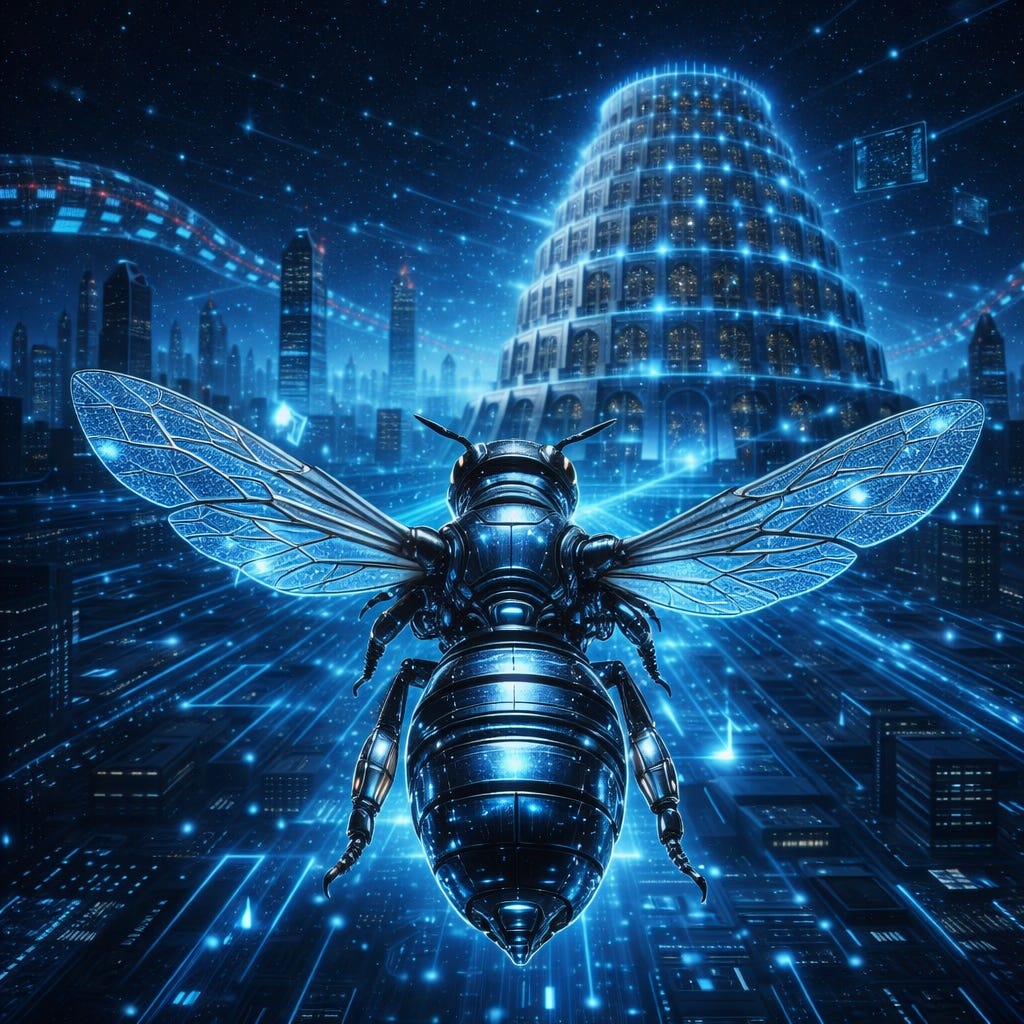
Synthetic image/AI-generated
This blog is written by Patrick Lacroix in a personal capacity. AI tools are used for research, structuring, drafting and language support. All content is selected, verified, and edited by the author, who retains full editorial responsibility.