

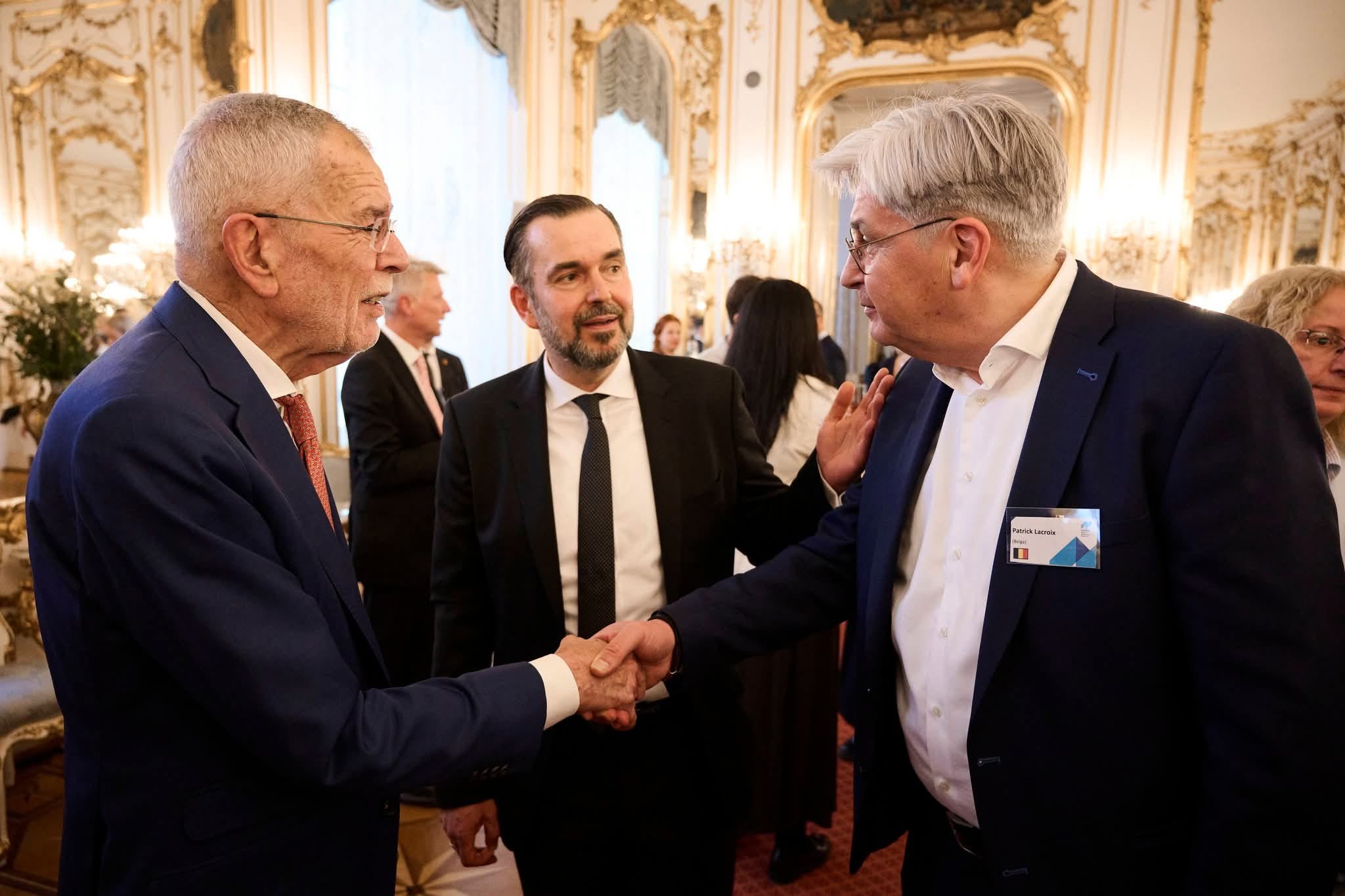
Copyright APA
In Vienna this spring, in the gilded rooms of the Hofburg, the future of Austrian public service media felt suddenly very concrete. At the reception hosted by President Alexander Van der Bellen, I had the privilege of congratulating Clemens Pig on his ambition to become
the future Director General of ORF, while shaking the President’s hand and realizing, very literally, how small our European media ecosystem actually is.
This is not just another personnel move in a national broadcaster. It is the moment when the operating system of a news agency meets the political and financial stress test of a public broadcaster under pressure.
A mandate that begins with subtraction
Clemens inherits an institution that will start his mandate with a large minus sign on its balance sheet. From 2027 onwards, the Austrian federal government intends to cut a yearly 93 million euro compensation related to the VAT treatment of the new ORF contribution. This is not an accounting footnote; it is a structural shock that will require deep re‑prioritisation, cost discipline and a strategic re‑design of ORF’s portfolio, from linear TV to digital services and regional offerings.
Every European public broadcaster knows the pattern. First, the political narrative of “efficiency” and “belt‑tightening”. Then, the slow erosion of the capacity to invest in investigative journalism, culture, regional presence and digital innovation. In Austria, the discussion is made even more acute by the simultaneous increase of media subsidies elsewhere in the system, while ORF is asked to do more with substantially less.
For an incoming CEO, this is the equivalent of taking command of a ship while the crew is told that one engine and several decks will be removed mid‑voyage.
From APA to ORF: the quiet power of the agency mindset
What makes Clemens’ move so interesting is precisely that he does not come from within the ORF hierarchy. He comes from the DNA of a cooperative news agency: APA, owned by ORF and the Austrian daily newspapers, where he has been the architect of a transformation that combined technology, shared services and an explicit commitment to public value journalism.
In a news agency, the business model forces you to think in systems, not shows. You optimise infrastructure, data flows, content pipelines and risk management across clients who are simultaneously your owners and your competitors. You learn to be radically boring where it matters (uptime, security, compliance) and quietly innovative where it creates leverage (automation, AI‑assisted workflows, data products). That mindset is exactly what a public broadcaster in fiscal and political turbulence now needs.
Clemens has argued consistently that European media should approach AI and platform power with cooperation rather than fragmented competition, stressing the need to pool data, technology and standards instead of fighting alone against structurally dominant US platforms. That is pure agency logic: no single player is big enough, but networks can be.
ORF as “platform of society” – if the budget allows
In his public statements after the vote in the ORF Stiftungsrat, Clemens sketched an ambition to turn ORF from a traditional broadcaster into a “platform of society”, with a structure that puts Finance, Technology & Innovation, Program & Brands, and Audience & Platforms on equal strategic footing. This is more than an org chart; it is an attempt to encode in governance the reality that audiences are now distributed, streaming is default, and public value is negotiated every day, not only at 8pm in the main news bulletin.
The problem, of course, is that platforms are expensive – especially when they are supposed to serve the entire population, safeguard democratic discourse, protect minors, comply with a growing stack of EU regulation (DSA, DMA, AVMSD, GDPR, AI Act), and invest in cybersecurity and resilience by design. A 93 million euro annual cut is, in that light, not a “saving”, but a forced re‑scoping of what “platform of society” can realistically mean.
Here, the APA experience is again relevant. Under Clemens’ leadership, APA invested early in data services, media monitoring and technological infrastructure that could be shared across clients, including ORF itself. The same logic could help ORF build a modular, interoperable platform architecture that reduces duplication, increases resilience and allows scarce innovation resources to be focused where they matter most.
Cybersecurity, trust and the new attack surface of public media
Readers of this dispatch know that I usually approach media stories through the lens of cybersecurity and systemic risk. ORF is not just another broadcaster; it is critical democratic infrastructure. When you add budget cuts, political pressure and accelerated digitalisation, you also enlarge the attack surface – technical, informational and institutional.
On the technical side, a more data‑driven, streaming‑centric ORF implies complex identity management, expanded content delivery networks, and more integration with third‑party platforms. That requires a security architecture that treats every integration as a potential vulnerability and every newsroom workflow as a potential vector for manipulation or data exfiltration.
On the informational side, the core asset to protect is not a server, but trust. Der Standard rightly points to the polarised debates around ORF, the politicisation of governance, and the expectations that the new General Director must rebuild and defend the broadcaster’s credibility in an environment of social media outrage cycles and disinformation campaigns. Trust, in this context, is a security perimeter.
And institutionally, the combination of external budget decisions and internal restructuring will create uncertainty among staff and leadership layers. That is when phishing campaigns, social engineering and insider risk thrive. A news‑agency‑trained CEO, used to thinking in terms of operational continuity and redundancy, has a better starting point to treat resilience as a core function, not as a side project.
What travels from APA to ORF – and what cannot
So what exactly can travel from the APA playbook into the ORF environment?
• A network mindset: designing ORF as a node in a European information and technology network, not as an isolated national fortress.
• A data and infrastructure orientation: seeing content, archives, and metadata as strategic assets that can be shared, licensed and recombined under strict governance, instead of being locked in siloed systems.
• A culture of cooperative competition: balancing the role of ORF as shareholder, client and competitor in relation to other Austrian media, and translating that into transparent governance, fair access and non‑discriminatory data‑sharing frameworks.
• A pragmatic approach to AI: using automation and machine learning to enhance journalistic workflows, reduce repetitive tasks and improve monitoring, while defending human editorial responsibility and explainability standards that are aligned with emerging EU regulation.
What cannot simply be copied is the relative political insulation that a news agency still enjoys compared to a public broadcaster whose leadership appointments are themselves objects of party competition. ORF is broadcast politics, not just media infrastructure. Here, Clemens’ own insistence that ORF must remain “unabhängig von Parteien, Interessen und einzelnen Milieus” will be tested not in strategy slides, but in the daily grinding reality of appointments, coverage decisions and budget trade‑offs.
A handshake in the Hofburg
At the end of the reception with President Van der Bellen, there was a brief, symbolic moment: a handshake, a few words about Europe’s media landscape, and Clemens standing a step behind us, already carrying the weight of an institution that still defines how millions of Austrians see their country and the world. The photograph below captures that moment as a reminder that democratic media are ultimately built on human relationships, shared standards and a willingness to carry responsibility in public.
In cybersecurity, we often say that “attacks follow value”. In European democracies, public service media remain high‑value targets: for budgetary re‑allocation, for cultural wars, for disinformation, and increasingly for technical attacks. The question is whether we can turn this moment of vulnerability into an opportunity for institutional hardening, regulatory clarity and renewed public engagement.
As Clemens prepares to move from the agency universe to the public broadcaster’s bridge, I can only wish him all the courage, clarity and resilience this moment requires. Having watched him build APA into a modern, cooperative backbone for Austrian and European media, I am convinced he is the right person in the right place at exactly the right time – and I look forward to seeing what he will make possible with and for ORF.
Sources
• Heute.at – Budget-Hammer: ORF muss auf 93 Millionen verzichten
• MeinBezirk – Budgetsanierung: ORF muss massiv einsparen, Medienförderung steigt
• Kleine Zeitung – Bundesregierung will 93 Mio. Euro beim ORF einsparen
• MeinBezirk – Tiroler Clemens Pig ist neuer ORF-Generaldirektor
• Deutschlandfunk – Medienmanager Clemens Pig zum neuen ORF‑Generaldirektor gewählt
• Heute.at – Neuer ORF-Chef: Clemens Pig hat nach Stunden Mehrheit
• Joyn News – Clemens Pig zum neuen ORF‑Generaldirektor gewählt
• diemedien. – Clemens Pig (ORF)
• Kurier – Der neue ORF-General: Wer ist Clemens Pig?
• Der Standard – Regierung will 93 Millionen Euro beim ORF einsparen
• Der Standard – Was Clemens Pig mit dem ORF vorhat