

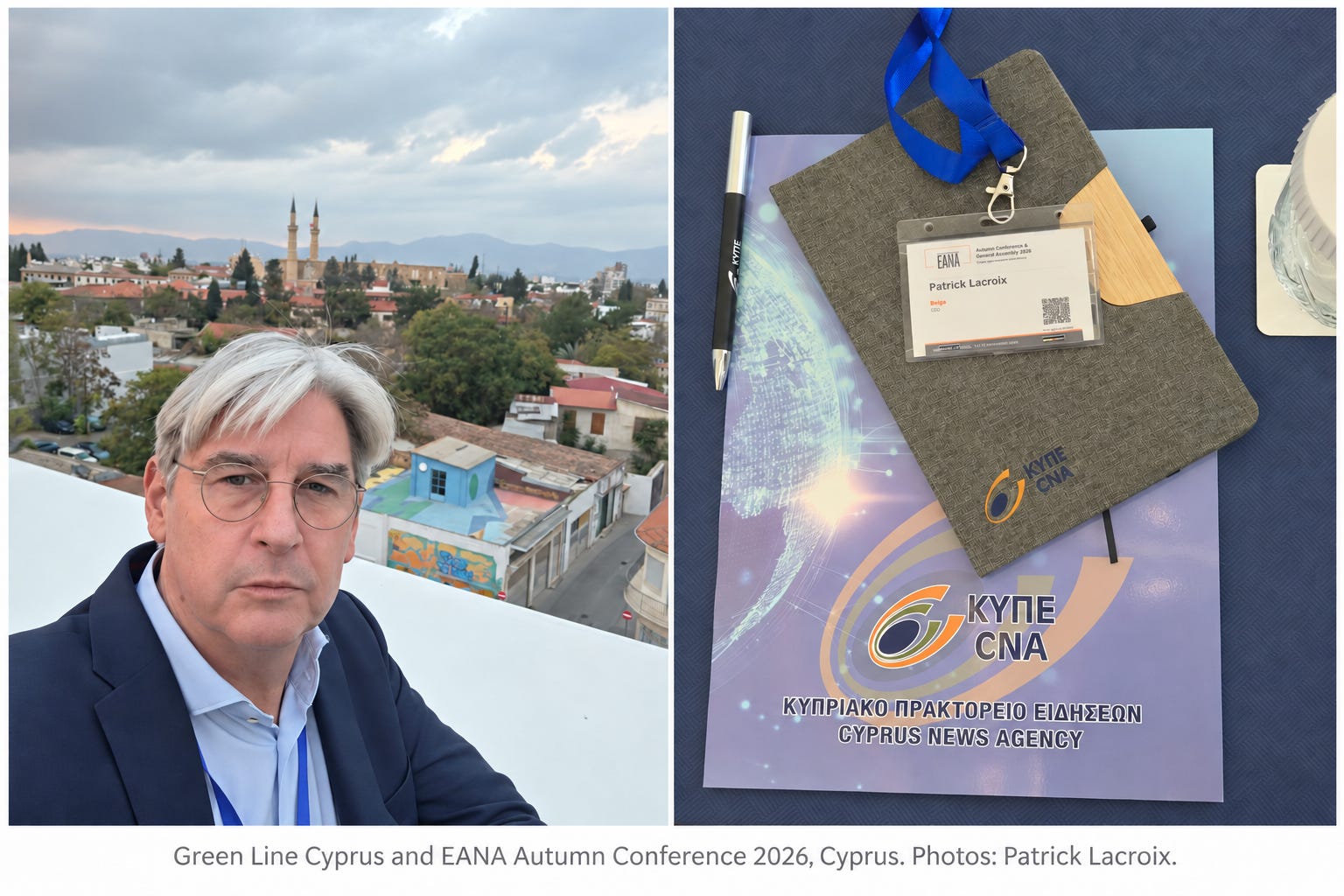
Visiting the Green Line in Nicosia this week felt surreal. The UN-patrolled buffer zone runs through the Cypriot capital, separating its Greek Cypriot and Turkish Cypriot communities. Within the same city, people live on opposite sides of a physical divide, with different accounts of the history that created it. That experience stayed with me during EANA’s autumn conference in Larnaca, where we discussed what independence means for a news agency, and what it takes to preserve it.
The discussions gave those questions a practical urgency. Political pressure tests editorial freedom. AI changes how reporting is used and paid for. Financial strain can dismantle a newsroom whose work an entire country relies on. Across the conference, independence emerged as something that has to be organised and sustained: through the people who establish the facts, the institutions that protect their judgement, and the business models that allow them to keep reporting.
Four contributions at the conference gave that discussion substance. Laurens Lauer, Postdoctoral Fellow at the Universities of Zurich and Vienna, examined how agencies recognise disinformation; Stefano De Alessandri, CEO of ANSA and President of EANA, considered who pays for reliable reporting; Tina Mari Flem, CEO of NTB and President of Minds International, described services for editors and their AI agents; Kimmo Laaksonen, CEO of STT, explained what Finland risks losing as STT prepares to end its news and picture operations. Together, they made independence tangible, in the daily decisions of people who produce news.
The international context was equally present: EANA expelled TASS on 13 November, days after Xinhua named the Russian agency among the first participants in an initiative to develop AI standards for media. These two decisions invite us to examine who defines trustworthy information, who supplies it, and which institutions can make that claim credible.
Patrick Lacroix is CEO of Belga News Agency and a member of EANA’s board. He writes Cyber Territories in a personal capacity. The accounts of the conference presentations below draw on his notes; paraphrases are not verbatim quotations.
I. On the responsibilities of an alliance
A professional alliance gives its members recognition as well as a place to cooperate. Its membership decisions therefore have consequences beyond the meeting room.
35.1: EANA excludes TASS and welcomes ELTA
At its general assembly in Larnaca, EANA expelled TASS, admitted Lithuania’s ELTA and elected Valbona Zhupa, director general of Albania’s ATA, to its board for a three year term. Zhupa succeeds Claudia Nicolae of AGERPRES, according to the published announcement. I warmly welcome our Lithuanian colleagues and congratulate Valbona, with appreciation for Claudia’s contribution. The decisions express two responsibilities of an alliance: determining the conditions of membership and sustaining cooperation among the agencies that accept them.
EANA communicated the decision in a brief, factual statement. TASS took another view. As a member of EANA’s board, I see the decision as a matter of institutional credibility: membership carries professional responsibilities, and an alliance must be prepared to uphold the principles that bring its members together.
Membership of an Alliance of News Agencies and journalistic use of a source require different judgements. A newsroom may need to consult a state agency to understand what a government says, while assessing its claims against other evidence and identifying its relationship to power. An alliance’s recognition adds another kind of authority.
Reflections
What obligations should an alliance attach to the recognition its membership confers? How should newsrooms explain their use of a source whose institutional independence they question?
II. On the work that makes information trustworthy
An authentic recording can support a misleading story. Verification requires attention to the claim made about the material as well as to the material itself.
35.2: Laurens Lauer puts context at the centre of verification
A photograph may show exactly what happened and still mislead a reader if someone supplies the wrong date or location. Laurens Lauer, presenting research commissioned by EANA, said respondents encountered manipulation of existing material more often than complete fabrication. A recent AFP verification established that footage presented as a demonstration by garment workers in Bangladesh actually showed a march in Manipur, India, using earlier footage, agency photographs and street imagery. The editorial work consisted of establishing the event and testing the description attached to it.
Lauer presented a survey that was conducted in March and April 2026 among EANA members, and revealed twelve agencies describing the threat of disinformation as high or very high.
Laurens Lauer’s presentation raised a practical question: how well do news agencies understand the disinformation they encounter? His Swedish and Dutch examples were revealing. Daily encounters with misleading material could coexist with a relatively low assessment of the threat. Familiarity, confidence and detection capacity all shape how a newsroom interprets its environment. An agency reporting few incidents may simply be less equipped to recognise them.
That makes verification an organisational capability. In Lauer’s findings, specialist teams were associated with stronger awareness of disinformation, while expertise and training remained important constraints.
The nature of the manipulation matters too. Agencies described misleading uses of genuine material as more common than outright fabrication. A photograph can be authentic and still be attached to the wrong event. A quotation can be accurate while its presentation distorts what the speaker meant. This becomes especially relevant when AI systems retrieve individual images, statements or facts and assemble them into a new account. Establishing where a component came from is one check; establishing whether its new use is justified is another.
Lauer also identified a concrete opportunity for EANA. Members showed interest in sharing expertise and developing early warnings. Cooperation could allow one agency’s verification work to help another recognise a claim before it spreads further.
For agencies moving towards services designed for AI agents, the lesson is consequential: the evidence, context and corrections supporting a piece of reporting need to travel with it. Verification becomes part of the service the agency provides, and part of what the customer pays to preserve.
Technical security adds a separate responsibility: on 11 November, Ukrinform’s director confirmed that attackers had altered its website and X profile. The pro-Russian message described in that report does not, by itself, identify the attacker.
Reflections
What would help an agency distinguish improved detection from a growing threat? How could agencies share a warning quickly while preserving the uncertainty that still surrounds it?
III. On paying for the reporting
Verification takes time, and time has a cost. The commercial relationship needs to recognise the work required to produce information that deserves confidence.
35.3: Stefano De Alessandri connects the quality of an answer to its cost
Stefano De Alessandri, ANSA’s chief executive and EANA’s president, drew on the economics of Italian coffee to explain why AI companies should pay for journalism. A coffee producer pays growers a premium for good beans because quality begins upstream: even the finest machine cannot compensate for poor ingredients. The same logic applies to AI. Investment in computing depends on a continuing supply of reliable information, produced by newsrooms with the resources to establish what has happened. Paying for that reporting is part of the cost of providing trustworthy answers. Preserving its value also means respecting the newsroom’s freedom to investigate whoever pays for access, including the technology company itself.
The difficulty is agreeing how that value returns to its producer. De Alessandri estimated that bots account for roughly half of ANSA’s website traffic, while the agency often struggles to identify their operators and purposes. For publishers, Ziff Davis’s reported 37 per cent fall in organic Google referrals in the third quarter illustrates the pressure on a familiar means of earning income, although that figure alone cannot establish how much AI contributed. Appearing in an answer, receiving a visit and earning money are separate outcomes; a sustainable agreement needs to address the relationship between them.
I find Stefano’s argument persuasive because it starts with the quality of the service being sold. An answer about a court case, a factory closure or a minister’s decision gains value from reporting that someone has checked and can correct. The cost includes maintaining the capacity to cover the next event, even when a customer cannot yet say which event it will need to understand. A licensing negotiation should leave room for that continuing service, alongside the measurable uses of individual stories, images and recordings.
Reflections
How should a price recognise both the use of a particular story and the availability of a dependable reporting service? What information would let both parties assess whether an AI agreement sustains the journalism on which it depends?
35.4: New agreements test how access, measurement and payment fit together
Yahoo has become the first licensee of the Internet Licensing Collective, according to Digiday’s report of 12 November. The arrangement allows participating publishers to receive payment for uses of their content in Yahoo’s AI search service Scout, with separate allocations for each licensee, cofounder Doug Leeds explained. The disclosed arrangements establish a commercial experiment whose financial results remain to be demonstrated. Collective administration could make negotiation more accessible to smaller organisations, provided they can understand the permitted uses, the calculation of their share and their ability to choose counterparties.
Europe’s legal work continues alongside those experiments: on 12 November, France’s National Assembly approved the joint parliamentary committee text on strengthening the effectiveness of neighbouring rights for publishers and press agencies, by 59 votes to zero. That vote establishes a legislative step; it should not be read as proof that every provision is already in force or that every AI use has the same legal treatment. Training a model, retrieving reporting for a current answer and republishing material describe different activities. Their contractual treatment should specify what the customer may do, with which content, for how long and under which reporting obligations.
This is law in search of equilibrium. Litigation helps establish legal boundaries, while negotiations determine workable conditions and prices within them. For news organisations, the quality of an agreement will depend partly on whether its income supports further reporting and whether its terms preserve editorial freedom. A newsroom should remain free to investigate a paying customer, and that customer benefits from buying information whose production it does not control.
Reflections
Which decisions should a publisher retain when it joins a collective licensing arrangement? How can a contract make editorial independence a dependable condition of the service?
IV. On serving an editor and an editor’s agent
A customer may need a recording, a photograph or a few verified facts. The agency’s opportunity is to make each useful without losing its context.
35.5: Tina Mari Flem describes a more flexible agency product
Imagine an editor working on a story who needs the recording of a prime minister answering one particular question. Tina Mari Flem, NTB’s chief executive and chair of MINDS International, described a project with Schibsted that starts from this kind of request. The two organisations are exploring how an editor’s AI agent could retrieve an individual recording, photograph or fact box, rather than requiring the customer to use a finished agency article. Flem’s term, “liquid journalism”, describes flexibility in the form of the product; the project is still in development.
Her football example made the practical benefit easier to understand. She described a photographer’s image reaching VG’s picture desk within seconds, with NTB’s facial recognition system adding players’ names to the metadata while the photographer continues working. Separately, Norway’s Project Reynir is piloting Content Credentials with VG, Bergensavisen and Adresseavisa, with visible implementation still under development. An image’s recorded history, the accuracy of its caption and the customer’s permission to publish it answer different questions, all relevant to an editor deciding whether to use it.
The product implications extend beyond fast retrieval. In my view, a useful service would preserve the origin, date, current version, permitted uses and available corrections of each component, so that an editor can understand what the agent has selected. Publishers have a reciprocal interest here: the care they expect from technology companies also matters when their own systems retrieve another newsroom’s work. An agent that produces an attractive draft should still allow its customer to establish where the reporting came from and whether the intended use respects the agreement.
Reflections
What context must remain attached to a recording or fact box when an agent retrieves it? How should a publisher apply its own expectations about attribution and permission to the systems it uses?
35.6: Agencies develop technology that other customers can buy
Flem also described a change in NTB’s capabilities: from roughly six developers in 2018 to around fifty today, alongside a similar number of journalists. In her account, technology income helps sustain journalism, while newsroom experience helps the agency build useful tools. TT’s Elephant CMS, winner of EANA’s 2026 Maxim Minchev Award, provides a related example: NTB became the system’s first external customer in May. An agency develops software for the demands of its own newsroom and finds that a colleague elsewhere faces sufficiently similar demands to buy it.
At the Web Summit in Lisbon, Reuters president Paul Bascobert and AP executive editor Julie Pace discussed AI agents as an additional category of customer. The same report describes Reuters’ MCP service, a standard connection through which a customer’s AI system can search agency material. In Taiwan, Florent Daudens describes Central News Agency’s subscription service for connecting its reporting and databases to a user’s own AI assistant. That CNA is Taiwan’s agency, distinct from the Cyprus News Agency that hosted us in Larnaca.
These developments give agencies several ways to earn income: a newsroom tool, access to a trusted collection, or a service that helps a customer use reporting within its own systems. The business question is how those revenues contribute to the cost of maintaining the journalism, alongside the engineering and customer support they require. Each agency will have to assess the balance for its own customers and resources. What I welcome in Tina’s account is the connection between understanding editorial work and building something people find worth buying.
Reflections
Which customer needs can an agency serve especially well because it produces journalism itself? How should it judge whether a technology business strengthens its capacity to report?
V. On the future our Finnish colleagues are trying to preserve
At STT, the discussion concerns people facing the end of their work and customers preparing for the loss of a shared service. That deserves both solidarity and a careful account of the choices.
35.7: Kimmo Laaksonen explains the pressure on shared reporting
STT’s board announced on 29 October that its news and picture operations would end on 31 March 2027, while its press release distribution business would continue. The company cited sustained losses, insufficient savings and the failure to secure a sufficiently broad group of committed owners. Hearing Kimmo Laaksonen explain the situation brought those formal words closer to the daily reality of a newsroom. Colleagues continue to serve customers while trying to preserve a future for work they know their country needs.
Laaksonen described Sanoma’s decision to invest more in distinctive journalism within its own titles, using AI for some monitoring and draft preparation. He put its ownership at 75.4 per cent and its purchases at about €3 million out of STT’s €12 million in revenue, figures from his presentation. A large publisher may reasonably judge that more of its budget should support reporting that distinguishes it from competitors. When that publisher is also the main owner and customer of a shared agency, its choice changes the cost and availability of the service for everyone else.
This makes the discussion more difficult, and more useful, than attributing STT’s problems to AI alone. The other customers may still value the agency while lacking the means to replace a major contribution or finance the next stage of development. Smaller newsrooms then face decisions about which coverage they can preserve, while agencies abroad must consider how they will obtain dependable reporting from Finland. For those of us who rely on this cooperation, STT’s future concerns the quality of our own service as well as the future of our Finnish colleagues.
Reflections
How should publishers assess the wider consequences of a purchasing decision that changes a shared reporting service? Which commitments could preserve that capacity while allowing each customer to develop its own journalism?
35.8: STT’s reporting shows what a rescue would need to sustain
Laaksonen described a proposed “fact pool” in which journalists would assess incoming material and AI would help search the archive and flag possible inconsistencies. His most favourable scenario would retain around fifteen journalists and six photojournalists, with an estimated €3 million to €4 million in financing needed over two years; he presented this as a proposal awaiting approval. Separately, Suomen Kuvalehti reported parliamentary interest and a working group exploring alternative ownership and governance arrangements. Those efforts establish possibilities, with customers, finance and the final operating model still to be secured.
A recent story gives the financing question a very concrete meaning: STT obtained documents about Google’s data centre project in Muhos and examined what the company and municipal officials knew about environmental problems. The article includes responses and describes a police investigation into suspected environmental damage, which should remain distinct from any finding of guilt. Someone had to request the correspondence, read it, compare dates and ask further questions. An archive makes earlier reporting available; maintaining this capacity means funding the next request and the next conversation as well.
Laaksonen’s warning about time deserves particular attention: customers seeking replacements can make their choices before the announced closing date. Any alternative needs commitments soon enough for customers and staff to consider it credible. Public support also requires precision about its status: the Finnish ministry’s statement of 30 September paused preparation of a €1.05 million aid package pending decisions about STT’s future, leaving any financing for a new service to be confirmed. My hope is that the efforts to preserve the service can bring together a workable offer, committed customers, independent governance and the means to retain the people who would deliver it.
Reflections
What would Finland lose if the next investigation of this kind had nobody available to pursue it? Which commitments must a rescue secure before customers and journalists have to make other arrangements?
VI. On public value and editorial freedom
An agency can earn commercial income, sell public services or receive public support. Each arrangement deserves scrutiny of the authority it gives the person paying.
35.9: Different funding models require credible safeguards
Stefano De Alessandri described public service contracts as accounting for about a third of ANSA’s turnover, with staffing and territorial coverage among the considerations. In Switzerland, the Federal Council has allocated CHF 6 million annually to services from news and audiovisual agencies under measures taking effect in January 2027. The announcement concerns a category of services and identifies no sole agency beneficiary. These approaches recognise that reporting has value for several customers and for the wider public, while leaving an essential question about how to finance it without determining its conclusions.
Our host country made that question explicit: President Nikos Christodoulides defended investment in the Cyprus News Agency and stated his government’s respect for its administrative independence. In Spain, EFE president Miguel Ángel Oliver described the agency’s public mission as distinct from serving the government. In Portugal, Lusa’s editorial council opposed Diana Ramos’s nomination as director of information, while its statement also acknowledged the regulator’s validation of the appointment’s legitimacy. The disagreement illustrates why editorial confidence and legal procedure deserve separate consideration.
These examples caution against judging independence from the ownership label alone. A commercial customer, a controlling publisher and a public authority can each influence an agency’s financial circumstances; the relevant assessment concerns what they can require in return. Transparent mandates, dependable funding, accountable appointments and an editor’s ability to publish unwelcome findings provide more useful tests. Agencies also owe their funders an intelligible account of what the service costs and delivers, with the boundary between that accountability and editorial control made explicit.
Reflections
What evidence would demonstrate that a publicly funded agency can report independently on its funder? How can commercial and public customers assess value without acquiring authority over editorial decisions?
VII. On who defines trustworthy AI
International cooperation can improve journalism and technology. The institutions that organise it also influence which standards acquire authority.
35.10: Beijing gives the standards debate a geopolitical dimension
Before our meeting in Cyprus, Xinhua and Beijing’s municipal government hosted the seventh World Media Summit, from 5 to 9 November. Xinhua’s account of a discussion involving AP, Reuters, AFP and CNN emphasised verification, traceability and responsible use of AI. In a Xinhua interview republished by The Borneo Post, AFP chairman Fabrice Fries described AI assistance while retaining human decisions about verification and publication. These are recognisable professional concerns, and participation in the discussion should remain distinct from endorsement of every initiative announced at the summit.
The institutional choices matter: Xinhua announced an approximately two year programme to develop AI application standards, naming TASS and Bernama among its first 22 participants. Within the same week, EANA decided to exclude TASS. Meanwhile, Kondrashov invited organisations and individuals to join the Global Fact-Checking Network that TASS helped establish. An announced standards programme still requires standards, and an organisation describing itself as a factchecker still has to demonstrate methods, evidence and a dependable process for correcting mistakes.
I would apply those tests consistently, including to organisations with which I feel more familiar. Xinhua’s meeting with dpa chief executive Peter Kropsch, also in Beijing, discussed cooperation in AI and media innovation; international contact can be useful without implying agreement about political or editorial authority. The practical questions concern access to the evidence, the freedom to contest a conclusion and the independence of those assessing compliance. Lauer’s emphasis on demonstrable verification is relevant here too: confidence in a standard depends on how organisations apply it when the facts are inconvenient for themselves.
Reflections
How should news agencies assess a standards initiative whose participants have different relationships with political power? What would make its verification and correction procedures credible beyond its own membership?
VIII. Agency watch
The wider agency news adds practical examples of the same responsibilities. Leadership, customers, staff protection and archives each contribute to the ability to keep producing useful journalism.
Bulgaria’s next vice president: Bulgaria’s Central Election Commission declared Iliana Iotova and Kiril Valchev elected president and vice president following the November runoff. Valchev’s change of role makes leadership continuity at BTA a subject to follow.
MTI’s leadership selection: Hungary’s Independent Public Media Board has opened a competition for MTI’s chief executive position, with applications due on 1 December, according to MMOnline. A published selection process gives interested readers something concrete to examine. The eventual appointment, mandate and practical scope for editorial independence deserve continued attention.
dpa’s business customers: dpa announced Corporate Insights for companies and associations, including coverage of medium sized businesses and material prepared for AI applications, with a planned start on 1 November. The offer adds another possible customer base for agency reporting. Its longer term value will depend on demand and on the contribution it makes to a sustainable editorial service.
Protection while reporting: AFP has denounced violence by law enforcement officers against its journalists covering demonstrations in France, reporting injuries to members of its staff. These are the agency’s stated accounts and concerns. The ability to record events depends on working conditions in which journalists can identify themselves and do their jobs safely.
New forms of intimidation: OCCRP’s Paul Radu warned of spyware, legal pressure and uses of AI to identify potential litigants against investigative reporting. His account gives news organisations another reason to consider legal, physical and digital protection together. Those costs belong in a realistic assessment of what original reporting requires.
Archives in public view: ANSA presented its exhibition on eighty years of women’s achievements at the European Parliament, while AGERPRES displayed photographs from Nadia Comăneci’s life and career in Vaslui. Such exhibitions let the public see agency work outside the daily news cycle. They also show the lasting value of the decision to send a photographer, preserve a negative and record a name correctly.
IX. Back to Nicosia
I return to the Green Line in Nicosia with a more practical understanding of the week. A declaration of independence gives a newsroom a principle to defend. Its ability to act on that principle depends on the people it employs, the arrangements that finance it and the freedom it retains when a customer or an authority would prefer a different story.
The four contributions at the EANA conference in Cyprus where highly relevant for that reason. Laurens described the work needed to assess a claim; Stefano considered the economic relationship that can sustain it; Tina showed how agencies can make their reporting useful to new customers; Kimmo reminded us how quickly the capacity to do that work can become uncertain. Our own responsibility is to connect those questions while the people and the options are still available.
I keep thinking about the documents obtained by STT on the Google data centre project. Correspondence that an official had written for an administrative purpose became material a journalist could examine, question and explain to the public. The capacity to ask for the next document deserves a place in the price of the service, in public policy and in our expectations of AI.
That is the independence I want us to be able to preserve: a newsroom with the means to ask another question, including a question addressed to whoever helps pay its bills. The usefulness of tomorrow’s answers depends on someone being able to do that work today.