

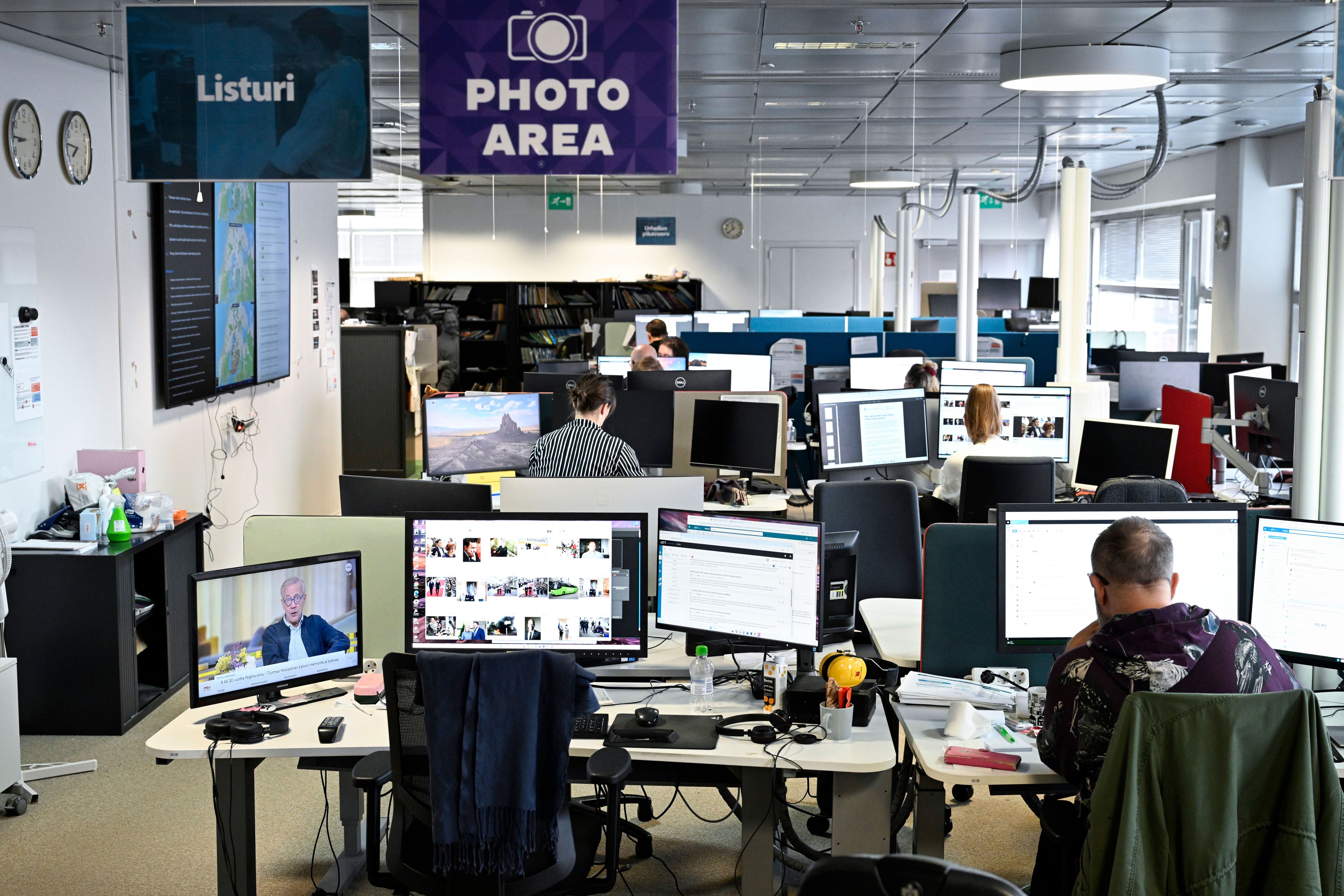
STT News Agency, Helsinki (Emmi Korhonen/LEHTIKUVA/SIPA via Belgaimage)
On 29 October, Finland’s national news agency STT announced that its news and picture service will close on 31 March 2027, after 139 years. Finland elects a new parliament eighteen days later. The country with the longest border between the European Union and Russia will enter the final weeks of its election campaign without the newsroom that has supplied most Finnish media with verified national news since 1887.
The closure raises a question that reaches well beyond Finland. The country’s largest media groups report rising profits, while the journalistic infrastructure they share closes. Platforms and AI services put pressure on every news business, and that pressure forms the background of this story. The concrete break comes from purchasing decisions, competing production arrangements and the absence of a funding model for a service whose benefits extend to the whole of society.
This edition follows that question through the news of the past weeks. It starts with the closure and the reactions across Europe, then examines the causes: Meta’s commercial terms, the economics of AI answers, the move of news consumption to social platforms and the arithmetic of a shared newsroom. It continues with the responsibility of governments for primary source journalism and with the widening reach of organised disinformation.
The final chapters turn to innovation. Agencies such as Reuters, Yonhap and dpa build services for professional customers and for AI systems, and several strategists expect demand for verified information to grow as intelligence becomes cheaper. That prospect gives grounds for optimism, provided the institutions that establish the facts still exist when the demand arrives.
I. On the closure of a national news agency
Finland’s national agency closes its newsroom weeks before a general election, and its partners across Europe ask who will keep the common record.
33.1 — STT closes its news and picture service before Finland votes
STT’s board decided to end the agency’s news and picture operations after the change negotiations, the company announced on 29 October. Services continue as normal until 31 March 2027; STT expects to lose 89 of its 95 permanent positions, including 68 journalistic roles, and the fixed-term contracts or framework agreements of 30 people also end. STT Communication Services, the press release distribution business with seven employees, continues, and the company will explore commercial uses for its archive and the technology it has under development. Chief executive Kimmo Laaksonen calls the outcome a tragedy for Finnish society as a whole, and in the Finnish version of the announcement board chair Petteri Putkiranta speaks of a solution that nobody would have wanted.
Belga, the agency I lead, called the closure a serious blow to Finnish journalism and to international news coverage, because STT gives agencies abroad a reliable source of independent, verified news from Finland, with no alternative available, in a country with a strong tradition of press freedom, on the border with Russia and ahead of parliamentary elections. In recent weeks Belga rallied support within EANA and MINDS and contacted the Finnish ambassador and Belgian Members of the European Parliament. MINDS International warned that Finland risks losing its national news agency after 140 years, a serious setback for Europe’s democratic resilience given Finland’s proximity to Russia and the challenges of information warfare. The Union of Journalists in Finland called the news “devastating” and noted that Finland will become the only country in Western Europe without a national news agency.
The case has reached the European Parliament. Members of the European Parliament from fourteen countries, on the initiative of the Austrian MEP Lukas Mandl, put a parliamentary question to the Commission about the future of Europe’s news agencies, and according to the Austrian news agency APA they see the Finnish case as the symptom of a broad trend. A shared newsroom produces a public good on a private balance sheet, and Finland now shows what happens when only the balance sheet counts.
Reflections
What does an election campaign look like when no single newsroom keeps the shared record of what candidates said, and when? Which institution can take responsibility for a national news agency without acquiring influence over what it reports?
II. On Meta’s terms and the coalition they created
One clause in Meta’s commercial terms brought agencies, publishers, broadcasters, courts and competition authorities into the same debate within three weeks.
33.2 — Meta’s terms bring the news sector together
Meta’s new commercial terms for business accounts, as Nieman Lab reported, authorise automated tools to access, collect and analyse content on websites “associated with” a business account, and Meta planned to apply them from 30 October. After criticism, Meta removed the word “train”; attorney Matt Topic considers “develop” broad enough to include training, and law professor Benjamin Sobel notes that compliance with robots.txt remains voluntary. Virtually every news organisation holds a Meta business account, so the clause concerns the entire sector. Andrew Moger of the News Media Coalition answered with an ironic letter of thanks to Mark Zuckerberg for “bringing everyone together”, naming among others the EPC, EANA, WAN-IFRA, the News Media Association, the EBU, NTB, STT and Belga.
EANA asked Meta on 23 October to remove the website crawling clause; secretary general Alexandru Giboi warned that Meta would have the content of news organisations “served on a platter”, so that journalists would “practically work for Meta”, and EANA asked for a binding commitment to robots.txt and a separate, opt-in, licensed and remunerated arrangement for journalistic content. MINDS International followed from Frankfurt on 27 October with a statement titled “Copyright Must Be Respected”, in which Wolfgang Nedomansky and Tina Mari Flem call on governments and regulators worldwide to “act now”. WAN-IFRA wrote to Meta’s Joel Kaplan to suspend the clause, the EBU demanded a genuine, non-retaliatory opt-out and noted that broadcaster websites carry agency photographs and news agency content that broadcasters cannot license to others, and the European Publishers Council asked the Commission to secure interim measures under the Digital Markets Act, or an undertaking from Meta, before the new start date of 20 November. Their demands converge on binding limits to collection, a separate licence for any further use and the right to refuse without penalty.
The coalition extends beyond Meta and beyond Europe. On the eve of the EU-Canada summit in Montreal, European and Canadian publishers’ associations formed a transatlantic coalition that asks for rules that let publishers authorise, monitor and enforce the use of their content, and the coalition statement published by the German publishers’ association MVFP presents the content telemetry standard of the SPUR coalition as a practical basis for accountability. “That work has a cost, and it has value,” the coalition writes about journalism.
Reflections
When a platform becomes a main gateway to the audience, what does consent to its terms still mean? How can agencies, publishers and broadcasters keep the coalition that Meta created once the immediate pressure eases?
33.3 — Courts and competition authorities test Meta’s terms
Ten Norwegian media companies, among them NRK, TV 2, Schibsted, Amedia and the agency NTB, took Meta to court with three demands: respect technical reservations such as robots.txt, conclude voluntary paid agreements for AI training and refrain from penalising media that refuse. NTB’s editor-in-chief Tina Mari Flem called the case historic because the sector stands united, and Euronews described the all-or-nothing choice that critics see between accepting the terms and losing a presence on Facebook and Instagram. One day after the filing, the Oslo District Court granted a temporary injunction that bars Meta from applying the contested terms until a court has assessed their legality, and ordered Meta to pay NOK 1.2 million in costs. In Brazil, the newspaper association ANJ announced an urgent legal action on behalf of its members.
Competition authorities move in the same direction. The UK Competition and Markets Authority opened an investigation on 30 October into whether Meta abuses a dominant position with these terms, after concerns raised by the News Media Association and the Movement for an Open Web, and separately requested information on the Meta One subscription and its effect on posting external links. In France, the Paris Court of Appeal rejected Meta’s appeals against interim measures of the competition authority on neighbouring rights; French media have received no payment from Meta since 2025, and the court found that Meta’s practices may amount to an abuse of a dominant position. In Denmark, Ritzau considers leaving Facebook; the agency has no website of its own, yet its customers share Ritzau content on the platform.
On 28 October, Meta promised a full consultation with industry groups before any change, while its existing terms stay in place; US senators Adam Schiff and Marsha Blackburn had separately urged Zuckerberg to withdraw the new terms. WAN-IFRA set out what that consultation must deliver, including terms agreed with publishers of every size and the right to refuse without penalty, and Irene Lanzaco added that “no publisher should have to surrender its rights as the price of reaching its readers”. News Media Canada’s Paul Deegan asked Meta to leave its “delay, deny (and) defend mode”. This is law in search of equilibrium, in which lawsuits draw the boundaries and negotiation will have to set the price. To be continued.
Reflections
What should a consultation produce before publishers can treat it as a negotiation between equals? How long can a platform rely on its existing terms when courts and regulators in several countries question them at the same time?
III. On the economics of AI answers
AI services answer questions with journalism, and the means of refusal they offer come with a price of their own.
33.4 — AI answers change the economics of journalism
The Generative AI and News Report 2026 of the Reuters Institute, which includes Finland among its nine countries, finds that weekly use of standalone AI systems rose from 34 per cent to 51 per cent in a year in the six countries it tracks over time, and that 57 per cent of respondents saw AI answers in search results in the previous week. Use of AI for news rises more slowly, to 9 per cent, yet 17 per cent of AI news users say they used AI to get around a paywall, and respondents expect AI to make news less trustworthy, with a net balance of minus 17 points. In a US court filing, Digital Content Next reported that unique visitors to its members’ sites fell 26 per cent from 2023 to 2025 and that Google search referrals fell by an average of 22 per cent year on year during eight weeks of 2026.
The old arrangement of the web, in which sites allowed crawling in exchange for traffic, loses its balance with AI services. Cloudflare data reported by Business Insider show Anthropic’s bots crawling about 2,800 pages for every referral in early July, against three to one for DuckDuckGo; Anthropic disputes the methodology. Google built that arrangement, and its AI answers now weaken the open web on which its own search and advertising business depends.
The pressure extends to images and print. Getty Images filed for Chapter 11 bankruptcy protection on 21 October after its planned merger with Shutterstock collapsed, amid heavy debt and rising competition from AI-generated imagery, and in Belgium Mediahuis plans to cut up to 35 jobs, citing distribution costs that rose by about €25 million in three years and advertising revenue under pressure from international platforms. An answer that costs the reader nothing still rests on reporting that someone paid for.
Reflections
If convenience explains most AI use for information, what will still bring readers to the original source? How should news organisations price access to their reporting when the referrals that once financed it decline?
33.5 — Publishers may refuse, at a price
Kevin Kelley of Anthropic submitted an Internet-Draft for a machine-readable training preference, a token in robots.txt with which a site can express a preference about AI training; the Datatracker notes that the draft has no formal standing in the IETF process. According to The Verge, OpenAI, Google, Microsoft and Anthropic say they will respect the signal, and Microsoft plans to let publishers opt out of training or grounding separately, while their sites remain in Bing search whatever they choose. A year earlier, Cloudflare had added content signals to robots.txt that separate search, training and AI outputs, and publishers welcomed the nuance while asking for enforcement.
Even protection takes the form of a platform choice. Publishers may indicate that their work is unavailable for training, and must then weigh what that refusal does to their visibility in the new information environment. In a joint submission to the CMA, Impress, the Independent Media Association and three other publisher groups call the binary opt-out ineffective in a market where Google holds more than 90 per cent of UK search, note that content may already form part of training and grounding datasets, and ask for retroactive opt-out rights. Refusal can be technically difficult, economically punishing and unable to undo earlier ingestion.
The same logic now reaches AI agents. The Verge reports that websites shut out agents that shop, book and compare on behalf of users: Yelp admits agents that pay for its data licensing programme, Amazon sued Perplexity over its shopping agent, and Meta argues that “turning away a personal agent means turning away the customer behind it”. Access to the web becomes a matter of conditions, and a preference signal records a wish until a licence turns it into an agreement.
Reflections
What is an opt-out worth when it cannot reach content that a model has already absorbed? Which party should carry the burden of proving that an AI company respected a preference signal?
33.6 — Courts and lawmakers define the terms of use
On 20 October, the Amsterdam Court of Appeal ruled in a case brought by DPG Media and Mediahuis that HowardsHome infringed copyright and the press publishers’ right by collecting tens of thousands of news articles a day and reselling fragments to clients, the Dutch central government among them, as press alerts. The court rejected the text and data mining exception as a defence and reasoned that “the very fact that money was made from those fragments means that there is an infringement of the publishers’ rights”. DPG Media points out that many AI companies rely on the same arguments.
The two halves of the same equilibrium advance side by side. Press Gazette’s tracker records that Postmedia, Torstar, The Globe and Mail and The Canadian Press sued Anthropic on 21 October and that USA Today Co seeks $250 million from OpenAI, while Google pays more than 400 publications in its news AI pilot and the agreement between News Corp and Meta is worth up to $50 million a year. Lawsuits establish what the law permits; licences establish what the use is worth.
Europe now has to decide how much of this to settle in law. The European Commission’s consultation on copyright and AI remains open until 10 November, after an extension from 3 November, and every organisation that licenses content has reason to respond. At the Frankfurt Book Fair, Börsenverein president Sebastian Guggolz said that little had changed since the previous year and that most European publishers lack the means to go to court, while more than 120 publishers signed a “Frankfurter Appell” for transparency about training data and a licensing market with fair pay. Litigation draws the boundary, licensing sets the price, and transparency makes both enforceable.
Reflections
If commercial use of short fragments requires permission, what follows for AI systems that summarise the same fragments at scale? How can smaller publishers and agencies enforce their rights when litigation exceeds their budget?
IV. On audiences without a direct relationship
Social platforms bring news to more people than ever, while fewer of those people maintain a direct relationship with a newsroom.
33.7 — Publishers sell more subscriptions to fewer readers
Pew Research Center finds that 59 per cent of US adults get news from social media at least sometimes, with Facebook at 40 per cent and YouTube at 34 per cent for regular news use; among adults under 30, 43 per cent regularly get news on Instagram and 39 per cent on TikTok. Digiday reports, based on INMA research, that the typical publisher reaches a fifth fewer people a month than in 2019, yet sells 50 per cent to 85 per cent more subscriptions per quarter. In Switzerland, the Yearbook Quality of the Media of the University of Zurich finds that people who inform themselves almost exclusively through social media are more receptive to conspiracy claims, and 57 per cent of respondents consider disinformation a large problem.
Together these studies show three distinct problems. People see news without a direct relationship with a news organisation; part of the public lacks a sufficient repertoire of journalistic information, a vulnerability the Swiss research makes visible; and newsrooms become financially better at serving a smaller paying audience while a larger part of society escapes their direct reach. That third tension explains why the favourable subscription figures tell half the story.
The familiar ambition to reach young people on TikTok has therefore become too narrow a statement of the problem. The harder question is how journalistic production stays funded when consumption, recognition of the source, the audience relationship and revenue spread across different parties. Economic resilience for some news brands and a thinner public information base can coexist.
Reflections
What responsibility does a newsroom carry for citizens who never become its subscribers? How can anyone measure the value of journalism that reaches people through channels that hide its origin?
33.8 — Newsrooms and creators meet young audiences on their platforms
In the Netherlands, NDP Nieuwsmedia’s education programme Nieuws in de klas launched DRUK, a channel on Instagram and TikTok that brings journalism from 34 Dutch news titles to young people aged 12 to 16, always with a reference to the original news brand and article, and that prepares a presence on platforms without algorithms. Poynter’s MediaWise and Microsoft launched a Creator + Newsroom Studio that pairs five newsrooms, the Augsburger Allgemeine among them, with independent creators; the organisers note that more than a quarter of people worldwide get some of their information from creators.
A survey by Proof News and Sciences Po among 2,000 US adults found that source labels on short news videos increase trust. “It’s the act of showing it that matters,” says Jessica Yellin, founder of News Not Noise, who asks creators to sign a voluntary Creator Constitution on sourcing and corrections. Creators who show their sources build trust, and the strongest source they can show is a verified agency service.
Influencers and creators should subscribe to news agencies. Agencies have always served many outlets from a neutral position, and creators form a new and expanding group of outlets that need facts they can name, check and correct. A source label gains strength when the source behind it has a newsroom, an editor and a correction policy.
Reflections
What would a news agency service for creators need to include to justify its price? How far can a newsroom adapt its format to a platform before the platform owns the relationship with the audience?
V. On the economics of a shared newsroom
Finland’s media groups report solid results, which turns the closure of their common agency into a question about who shares the bill.
33.9 — Profitable media groups leave their agency without a funding model
Sanoma, which owns 75.4 per cent of STT, reported a 10 per cent rise in third-quarter adjusted operating profit to €190.0 million and expects its 2026 result at the higher end of its outlook, and its Media Finland division raised its adjusted operating profit by 10 per cent, with events offsetting lower advertising. Alma Media, which sold its STT shares to Sanoma in 2018, reports third-quarter revenue up 6.3 per cent and adjusted operating profit up 15.8 per cent, and its news division improved its adjusted operating profit by 6.3 per cent on stable revenue. Group margins say little about the margins of journalism, and these figures leave open whether every publisher could pay more for STT; they do weaken the idea that the Finnish sector lacks the means altogether.
The case study The Cost of Sharing the News by Polders.Media reconstructs the immediate cause. In September 2025, Sanoma announced that Helsingin Sanomat, Ilta-Sanomat, Aamulehti and Satakunnan Kansa would stop using STT’s services, purchases of nearly €3 million a year for an agency with a company-wide turnover of about €13 million, and STT’s operating loss more than tripled to €1.42 million in 2025, a year in which Sanoma still bought its services. With largely fixed costs, the remaining customers would have to pay about 30 per cent more to restore the previous position, and every price rise invites the next departure. The customers who pay most also publish the least identifiable agency material, from 63 per cent of published items at Salon Seudun Sanomat to 14 per cent at Helsingin Sanomat.
The departures have a longer history. Yle left the newswire in 2007 and returned in 2017, regional titles founded their own joint news service in 2010, Helsingin Sanomat left in 2015 and Iltalehti in 2017, and government purchases fell from about €2 million a year to close to zero. Finnish media groups can remain financially sound while their shared journalistic infrastructure loses its economic base; platform pressure may form the background, and the concrete break follows from purchasing decisions, competing production arrangements and the lack of a sustainable funding model. This is my synthesis of the documented customer history and the recent results, and it attributes no intention to the owners; the question it raises concerns the distribution of the remaining value within the sector, and who still pays for services whose usefulness extends beyond their own titles.
Reflections
Which journalistic functions are profitable media groups still willing to finance together? How should an agency’s prices reflect dependence on its service as well as audience reach?
VI. On public responsibility for primary source journalism
Independent reporting needs access, safety and a funding base, and governments can secure those conditions without steering the content.
33.10 — Primary source journalism needs access and protection
In Brussels, I spoke on behalf of EANA and Belga when the News Media Coalition presented its framework for primary source journalism in the European Parliament, the journalism that establishes what happens, checks sources and verifies facts before anything circulates further. Andrew Moger contrasts news organisations with the platforms: “They are not us. We are accountable, contactable, trained and human, and occasionally wrong.” CPJ and fifteen partner organisations asked the European Commission to end the delays, questionable refusals and heavy redactions that journalists face when they request its documents.
Access and safety come under pressure in democracies too. After journalists reported obstruction, forced removals and insults at a Rassemblement National rally in Orléans, forty-four outlets, AFP among them, signed an open letter that asks political parties to give the press access to their events. After the Serbian elections of 25 October, EANA condemned the threats against Tanjug and its staff and asked the Serbian authorities to investigate them promptly and thoroughly, a statement the Croatian agency Hina also carried. K1 and Tanjug suspended live programming for a day for the safety of their employees and reported the threats to the competent institutions, and a Tanjug source described the step to Vreme as a precautionary measure.
At the far end of the scale, Reuters reports that Novaya Gazeta will wind up its remaining operations on 9 November after a blocked website, a revoked print licence and seized presses, and the IFJ quotes its farewell letter: “The newspaper no longer exists.” Primary source journalism depends on access to events and documents, on the safety of those who report and on organisations able to pay for both. That independent capacity has a security function for society, and it can fulfil that function when journalists work independently of governments, companies and foreign influence.
Reflections
Which minimum guarantees of access and safety should every party and public institution offer journalists, whatever their outlet? How can news organisations in different countries support colleagues who face threats at home?
33.11 — Governments share responsibility for information infrastructure
In De Groene Amsterdammer, WAN-IFRA chief executive Stig Ørskov cites UNESCO’s Mariya Gabriel, who calls support for journalism democratic infrastructure, and describes UNESCO’s draft guidance on fair compensation, which combines bargaining frameworks, competition measures, funds and collective licensing. Ricky Sutton reports that Finland supported STT with €1.5 million in 2018, that a one-off €1.05 million proposed by minister Lulu Ranne in February 2026 never arrived, and that MINDS chief executive Wolfgang Nedomansky knows of no other agency without contracts with government or public authorities; Australia, by contrast, reserves a 5 per cent share of its News Bargaining Incentive for AAP. “If the publishers sneeze, the news agencies catch a cold too,” says STT’s Pihla Lehmusjoki.
Whether funding an agency still pays off for an individual publisher is a different question from whether a society can afford to lose that infrastructure. The European Federation of Journalists writes that “a national news agency is public-interest infrastructure: when it goes, regional and local media lose a vital source, and citizens lose access to trusted information.” The Nordic journalists’ unions add that “in a time of growing disinformation, foreign influence campaigns and increasing security challenges, strong and independent news agencies are more important than ever”. A public broadcaster serves viewers, listeners and readers; a news agency forms the base infrastructure beneath all media, the network that establishes facts and supplies them to media, companies and institutions, and it needs a financial backbone alongside the market to perform that public task.
Responsibility therefore shifts towards government, whose role is to create the conditions under which an essential, independent journalistic function can continue, without taking over journalism or steering its content. Finland considered support, and according to the Polders case study the government offered a one-off grant of about €1 million against an estimated need of €5 million to €7 million, which it had not paid when STT announced the restructuring. That finding differs from political indifference, and it remains serious, because the decision about STT’s future gives too little weight to the agency’s function for society. Beyond the question of who should pay for STT lies the question of who carries responsibility when a society loses independent journalistic capacity, and that responsibility cannot rest with commercial shareholders alone.
Reflections
What would a public-interest contract for a news agency need to contain to protect its independence from the government that pays for it? Who carries responsibility when a society loses the independent journalistic capacity it needs for its democratic resilience?
VII. On organised disinformation
Influence operations target elections, protests and trusted news brands across Europe, while the organisations that study them work with shrinking budgets.
33.12 — Influence operations retell France’s protests abroad
Alliance4Europe analysed 547,471 posts in nine languages about the October protests in France and found evidence that a foreign actor did amplify the anger before and after the protests, applauded violence and sought to divide French society. In the six weeks before 17 October, a bot network that the researchers attribute with high confidence to Russia’s Doppelganger operation posted 639 coordinated messages in French, German, English and Polish, with about 7.4 million views, and invoked the yellow vest protests to turn real grievances against support for Ukraine.
Once the riots began, about one in thirty-three French-language posts blamed migrants or Islam, against nearly one in five English-language posts, and the unfounded claim that immigrants had set fire to the town hall of Limoges circulated 3.6 times more in English than in French. The Pravda network published 1,018 articles across 28 sites, ten AI tools repeated its claims in a third of cases, and the researchers describe the network as designed to reach AI training data, a tactic called “LLM grooming”.
The French case is recent and disturbing because it shows the full cycle, in which a domestic protest becomes material for a story told abroad, in another language and hours ahead of the facts, before that story enters the systems people consult to learn what happened. Verified national reporting in the original language, published fast and kept on record, gives everyone a reference to check such retellings against. Disinformation exploits the time between an event and its verification, and news agencies exist to shorten that time.
Reflections
How fast must verified reporting appear to stay ahead of a retelling that starts in another language? What does it mean for news agencies when networks aim their content at the data from which AI systems learn?
33.13 — Elections across Europe meet the same techniques
Before the state elections in Berlin and Mecklenburg-Western Pomerania, fake videos spread claims of election fraud, linked to the pro-Russian Storm-1516 network, and state election chief Christian Boden told dpa that the AfD did appear on the genuine postal ballots. The DFRLab traced four false narratives about the Baltic states to accounts linked to Storm-1516, which used cloned websites and logos of media such as The Defense Post, Euronews and EUobserver. In Armenia, DFRLab, CivilNet and Erebus examined 45 campaigns, of which 15 alone generated more than 149.5 million views, and a BBC investigation into Moldova’s 2025 election found a paid network that trained recruits to write posts with ChatGPT and linked at least 90 TikTok accounts to it, some posing as news outlets.
Imitation of trusted news brands recurs in almost every case. At the EANA Spring Conference in The Hague, participants observed that news agencies increasingly become direct targets of influence operations, and Alliance4Europe presented a draft report for EANA’s Committee Against Disinformation. EANA president Stefano De Alessandri called news agencies “the backbone of Europe’s information ecosystem” and argued that countering disinformation requires strong, independent and sustainable news organisations.
The organisations that study disinformation face shrinking means. The Duke Reporters’ Lab counted three times as many closures as launches of fact-checking projects in 2025, and three quarters of the fact-checkers in an IFCN survey describe themselves as financially vulnerable, while EU DisinfoLab reports that the European Parliament, in its resolution on the European Democracy Shield, calls the implementation of the Digital Services Act “challenging and slow”, and that a French bill would require large advertisers to direct up to 10 per cent of their digital advertising budgets to recognised news outlets. Researchers and agencies are natural allies, because an agency brings a strong digital and organisational infrastructure, direct contact with public authorities and, in many countries, shareholders among its media customers who guarantee its independence. That alliance requires recognition of agencies as critical infrastructure, with a financial backbone to match.
Reflections
Which tasks could news agencies and disinformation researchers share while keeping reporting and investigation distinct? What happens to a country’s resilience when the organisation that verifies its news closes before the next campaign?
VIII. On agencies and newsrooms that rethink production
AI changes how newsrooms produce news and who receives it, and agencies that invest in their own tools find new customers.
33.14 — Sanoma rebuilds its newsroom workflow around AI
WAN-IFRA describes how Sanoma Media Finland set out to turn phone interviews into draft articles, working with Limecraft and a pilot group at Helsingin Sanomat, and found that the main obstacle was the inconsistent way journalists handled those interviews. “Defining good was actually even harder than building the AI tool,” one team member says. Futurice documents two earlier projects with Sanoma: Hennibot, an editorial insights tool that journalists use daily, and a recommendation engine for Helsingin Sanomat that processes about 30 million events a day and gives editorial directives priority over automated ranking.
STT is strong in rethinking news production itself. One plausible consequence of the closure, which remains a hypothesis, is that part of that know-how finds a new home within Sanoma, which said in February 2026, according to Polders.Media, that AI had strengthened its ability to produce its own basic news. That would reinforce the production of one group, while the market as a whole loses its shared supplier.
What one large group saves through its own production can make the market as a whole less efficient. When every group automates the same basic coverage on its own, several newsrooms organise identical reporting, smaller titles may lack the means to do so, and the collective function of the agency disappears even when its journalists, innovators and management find work elsewhere. The productivity of a shared newsroom multiplies across all its customers; the productivity of an in-house tool stays within one group.
Reflections
What happens to the efficiency of a national news market when every group automates the same basic coverage separately? How can an agency turn its workflow expertise into a service its customers prefer to buy?
33.15 — Agencies build for professional customers and machines
Reuters president Paul Bascobert told The Rebooting that Reuters works as a wholesale business for financial markets, media clients, consumers and AI and corporate customers, and grows 6 per cent to 7 per cent a year at 21 per cent margins with 2,600 journalists. Its FactGenie tool cut the average time from an announcement to publication from 1.5 minutes to about 33 seconds, with journalists verifying the output. “We compete on being right. We compete on being fast,” Bascobert says.
Yonhap started a trial of Yonhap LM on 20 October, an in-house AI application for search, analysis and fact-checking on its own archive, built with its own implementation of the Model Context Protocol, and its chief executive Hwang Dae-il wants Yonhap to be “a bastion of trusted journalism” at a time when false information spreads. dpa launches Corporate Insights on 1 November, a business news service for medium-sized companies that dpa-Basisdienst customers receive free of charge, and plans to prepare its content as structured data for AI applications. WIRED describes how Axios builds Axios Direct feeds designed for AI agents, while Rasmus Kleis Nielsen calls the market for such deals “extremely uneven”.
At Digital Media Europe, WAN-IFRA’s Ezra Eeman explained that news publishers account for about a third of citations in AI answers and that “journalism increasingly serves a need inside a larger task”. Agencies have long produced the news once, verified it and delivered it to many customers in many formats, and the third option in the Polders case study follows that logic, with an agency that sells verified facts and structured data to public bodies, platforms and AI developers, which spreads the cost of the common factual record beyond newspapers. The wholesale model suits an economy in which machines read the news alongside people.
Reflections
Which customers beyond publishers would pay for a verified national record in machine-readable form? How can an agency price access for AI agents while keeping control over the use that follows?
IX. On the wider view
Several strategists expect verified information to gain value as the open web changes and intelligence becomes cheaper.
33.16 — Verified information gains value as the web changes
In Axios ahead: 2028 and beyond, Jim VandeHei writes that “the value of verified, reported, distinctive truth and curated human connection will spike”, and describes Axios Direct as a business line that sells real-time feeds of vetted news to companies that build their own models. Ben Thompson declares that “the Internet as we knew it is dead” and expects the public internet to become less viable for independent sites, as AI consumes content and attention without returning traffic; drawing on Venkatesh Rao, he expects many smaller markets, in local communities and private networks, to meet needs that one global market used to serve.
FT Strategies, which assesses the AI readiness of publishers across eight dimensions, describes three governance models for scaling AI, a Centre of Excellence, embedded teams and a Centre of Enablement that combines central standards and expertise with capability in every department. An agency could play a comparable role at the level of a national market, with shared standards, verified material and technical expertise, while each newsroom keeps its own editorial choices.
These analyses share one assumption. As AI produces more text, the scarce input becomes, in the words of the Polders case study, “a verified, corrected and time-stamped record of what happened, held by an organisation whose reputation depends on getting it right”. That record has always been the core product of a news agency.
Reflections
If the value of verified information rises, which organisations will capture that value, those who produce it or those who distribute it? What governance does a news organisation need to scale AI while keeping full editorial responsibility?
Conclusion: Who will supply the facts in an age of abundant intelligence?
The closure of STT’s news and picture service is a warning about the fragility of Europe’s information infrastructure. Technology platforms have captured much of the attention and advertising revenue that once financed news media. Publishers, absorbed by their own economic transformation, understandably focus on their commercial survival, and nobody can reasonably expect their shareholders to finance an infrastructure whose benefits extend far beyond their own businesses.
Public responsibility begins at this point. Independent news agencies provide a critical service to democratic societies, and securing the conditions for their survival, with full respect for their editorial independence, is a legitimate task of government. Finland has so far found no sustainable framework for that function. The consequences reach beyond the loss of a supplier, because Finland risks losing its central hub for verified news, international coverage of Finnish affairs may become poorer, and the collective capacity to verify information, expose falsehoods and counter organised disinformation weakens at the moment those networks gain powerful technology and substantial resources.
The same technological revolution also offers a way forward. In Cognitive Mercantilism, Venkatesh Rao argues that the demand for intelligence “can grow as the cost of satisfying it falls”. He draws on Joyce Appleby’s history of capitalism, in which expanding trade in tea, sugar, tobacco and Indian cottons led British households to work more days a year, from about 250 to 300, in an “industrious revolution” that preceded the Industrial Revolution. Greater productivity expanded markets then, and cheaper intelligence may do the same.
For news agencies, this opens a real possibility. As AI helps individuals, companies and institutions analyse more information, follow more developments and make better informed decisions, their demand for reliable, current and verified facts may increase considerably. AI processes information at an unprecedented scale, yet it depends on trustworthy sources to know what happened in the world. The opportunity for agencies lies in becoming essential suppliers of verified information to an expanding number of human and machine users, alongside the defence of their existing markets.
That transition requires new business models, investment in technology, enforceable licences and recognition of the public value of independent news infrastructure, with commercial innovation and public responsibility reinforcing each other. A news agency resembles the office of weights and measures in a market town: every trader relies on it, no single trader wants to pay for it, and the market needs it most when trade expands. STT’s fate shows the danger of letting the old economic model collapse before a new one has emerged.
If intelligence becomes abundant, who will still have the means, the independence and the responsibility to establish the facts on which that intelligence depends?
Patrick Lacroix writes in a personal capacity. AI tools support research and drafting; he retains full editorial responsibility.