

Last week I spent two days in Stockholm at the 41st MINDS International Conference, with colleagues from news agencies in Europe, North America, Australia, Japan and India. On Tuesday I join a panel in the European Parliament organised by The News Media Coalition for the European launch of the Primary Source Journalism Framework. One question connects the two meetings: who will produce the facts that newsrooms, citizens and AI systems rely on, and who will pay for that work?
The Minds Conference in Stockholm showed a news agency industry that innovates with confidence. Agencies build services for AI agents, open their archives to new forms of search and study what their customers really need. The Brussels NMC Event will discuss the conditions underneath that innovation: access for reporters, photographers and video journalists, recognition of verified reporting and a fair reward for the people who do it.
The situation of the Finnish news agency gives both conversations a human dimension. On 30 September, STT announced negotiations on a restructuring that could end its news and photo services in March 2027. A week later, its colleagues spoke in Stockholm about the newsroom of the future. Their situation concerns every member of our community, and it connects the three chapters of this edition.
The first chapter looks at what Primary Source Journalism asks of policy. The second gathers what Minds Stockholm taught us about value, products and access. The third makes the case for a durable Finnish news agency and for institutions that protect editorial independence.
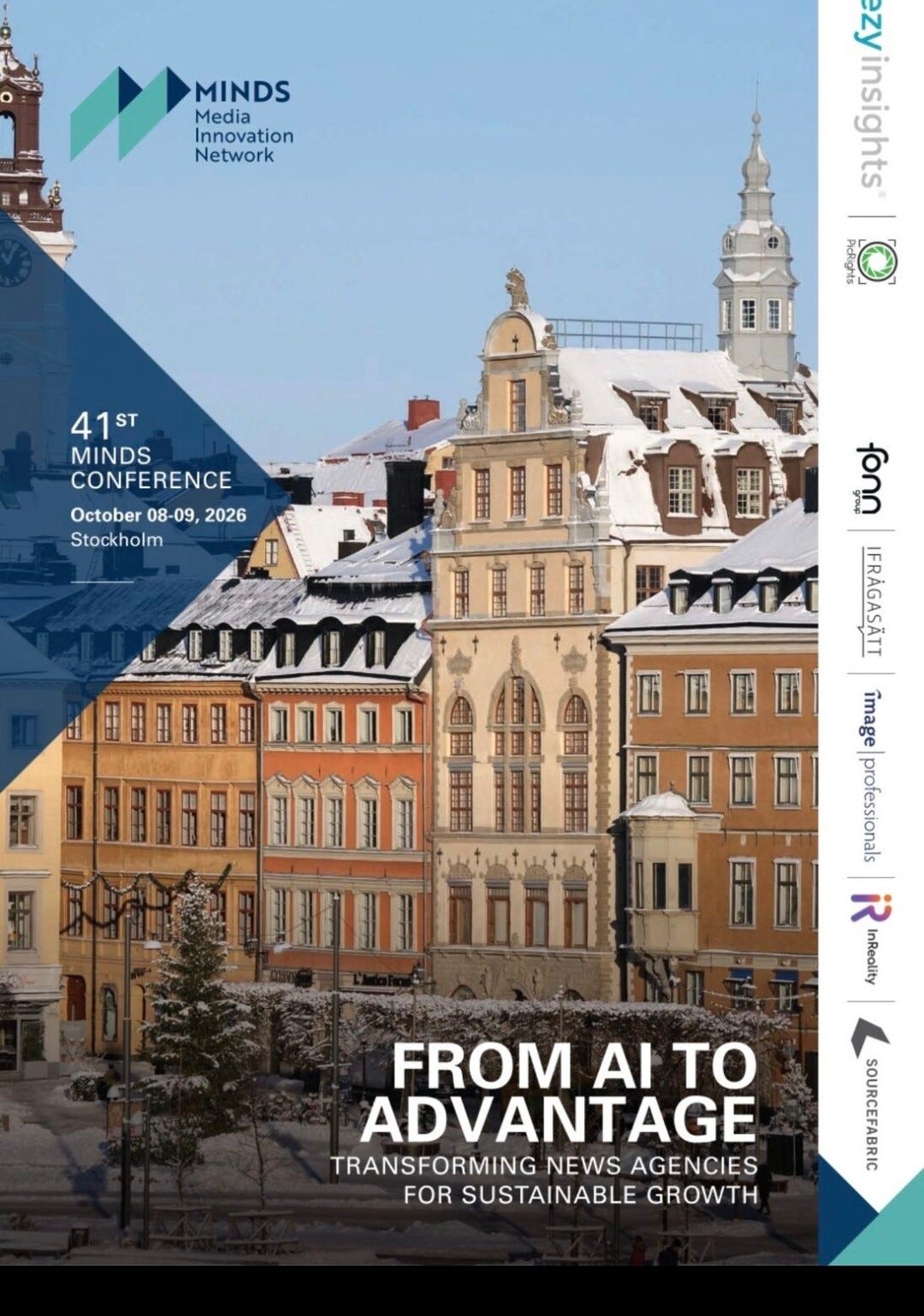
Minds International Autumn 2026 Conference Stockholm
I. On the conditions for producing facts
Every reliable answer starts with someone who went to look, asked the question and checked the claim.
32.1 — Brussels puts Primary Source Journalism on the policy agenda
The News Media Coalition describes Primary Source Journalism as the daily work of reporters, photographers and video journalists who gather news at first hand. Its framework sets out nine conditions, among them access, recognition of the investment behind newsgathering and the removal of barriers to new forms of reporting and distribution. An article by epd medien explained the framework in March and listed AFP, AP, dpa, the EPC and Guardian Media Group among the members. On 13 and 14 October, the coalition presents it to policymakers at an invitation-only event in Brussels, first in the European Parliament and then at the Residence Palace.
I take part in the panel on 13 October and speak from the perspective of a news agency. My starting point is access. Journalists need to remain independent public witnesses, and access has to evolve with journalism, video included. Primary Source Journalism is a method for establishing facts; that method deserves recognition and a fair reward, because somebody still has to finance the production of reliable facts if we want reliable AI.
At the EANA debate in Brussels last May, I described news agencies as part of Europe’s critical information infrastructure, and Andrew Moger of the coalition called primary source journalism the raw material of truth. The Brussels launch gives that idea a framework policymakers can work with. AI can transform the way people receive news. The news itself still originates with people who go and look.
Reflections
Which practical conditions allow journalists to remain independent public witnesses? How should access rules evolve now that video belongs to everyday reporting?
32.2 — Original reporting carries the cost of the facts
In its reading of Alessandra Galloni’s Andrew Olle Lecture, the coalition describes origination as the expensive part of journalism. It requires training, judgement and access, and in conflict zones also armoured vehicles, protective equipment and security advice. The same text notes that trust in news found through AI answers stays well below trust in news in general.
EFE’s nomination for the Daphne Caruana Galizia Prize shows what that investment produces. In “Noticias falsas, víctimas reales”, EFE journalists tell ten stories about the people who suffered the consequences of disinformation, in text, photography, documentaries, podcasts and mobile formats. The European Parliament announces the winner on 21 October in Strasbourg.
The Canadian Press describes the opposite case. Its reporters found AI personas presented as journalists on a site that repackaged reporting by CP and other outlets, and they reached no human through the contact address. Both stories make the same point about accountability: a newsroom can say who observed, who checked and who corrects.
Reflections
How can readers recognise the reporting work behind an answer or a summary? Which responsibilities should remain visible when an AI system reformats journalism?
II. On the value news agencies organise
The Minds Conference in Stockholm showed agencies that innovate with confidence and ask what their work is worth in an AI economy.
32.3 — Agencies build doors for AI agents
The Model Context Protocol, the standard that lets AI agents connect to outside services, was the most striking development of the conference. In my LinkedIn reflection on Stockholm I mentioned Tom Wuytack’s Belga presentation, “MCP: the art of managing opportunities”, with a fitting quote: “If opportunity doesn’t knock, build a door.” Jan Pluskal of ČTK also addressed MCP, and ČTK reported on his comparison of an MCP server with semantic search, alongside Gabriela Vostřezová’s presentation of PROTEXT GEO. PAP Intelligence works towards an agent layer with MCP as the integration layer for agency content, and Andreas Mauczka of APA described the shift towards agent-based distribution.
Product work follows the same logic. PAP launched MultiPAP in beta, one login for text, photos, video and infographics, together with its first new editorial system in seventeen years. At Kleine Zeitung, Sebastian Krause told Twipe that the paper blocks AI crawlers by default, opens access through TollBit and lets subscribers connect their own assistant at no extra cost. Florent Daudens adds that in a market of personal agents, being informative could pay better than being viral.
An agency that opens a door for agents also decides who may enter, for which purpose and on which terms. MCP handles the technical connection. Rights, authorisation, usage reporting and price each need their own agreement, and editorial responsibility remains with the newsroom.
Reflections
What should an agency offer an AI agent beyond a collection of articles? Which commitments on rights and service must remain explicit once machines can read our information?
32.4 — Human judgement defines the value of AI in newsrooms
All speakers at the Stockholm Conference placed people at the centre of their AI strategy. Astrid Maier of the German news agency explained why dpa made AI a strategic priority, Pihla Lehmusjoki of STT made a warm case for AI-native newsrooms and Agnes Stenbom of Schibsted offered a more philosophical view of human-centred hybridisation. In an interview with LA NACION, Stenbom locates the value of journalism in judgement, originality and empathy, and describes a newsroom role she calls the human judgement editor.
Martha Riemsma of the Dutch agency ANP gave the same idea an operational form. According to NPO Innovatie, ANP works with two AI editors, a traffic-light model for AI use and agents that screen research reports, and it discusses a protected public data space with two Dutch ministries. Martha gives the sector about two years to organise itself. In Stockholm she described a news agency that public authorities recognise as public infrastructure.
Efficiency matters, and the use of the time it frees remains a management decision. I would judge an AI investment by the extra capacity it creates for interviews, research, verification and service to customers. That is how technology strengthens the quality newsroom.
Reflections
Which human capabilities should an AI investment strengthen in a newsroom? How will leaders show that efficiency gains improve original reporting?
32.5 — Access, measurement and payment need separate agreements
Birger Soiland of TollBit showed in Stockholm how easily bots reach agency content; for many of us, a real eye-opener. Publishers respond with stricter defaults. Search Engine Journal reported in June that Reuters and Time now block AI crawlers by default and admit only approved partners.
Measurement comes next. SPUR has published a content telemetry standard that records when a system retrieves, grounds, cites, presents or engages with content, and it has invited the large AI companies to its advisory board; none has confirmed so far. Ulrike Langer of News Machines adds the question of audit: a publisher needs a way to check what a customer reports. In Stockholm, Fredric Karén of Schibsted gave a first-hand account of the OpenAI partnership, and Patrice Monti of AFP added the AFP perspective on the Mistral partnership in the debate on the value of agencies for AI.
Policy remains part of the equation. In Australia, ABC and SBS ask that the news bargaining incentive also cover AI companies, and SBS writes that crawlers routinely ignore or bypass robots.txt. Nieman Lab showed earlier this year that some publishers now limit the Internet Archive as well, which reminds us that protection of rights and preservation of the public record both deserve attention. Legal claims set the boundaries; licences set workable terms, and together they create a business model.
Reflections
Which evidence should a content owner receive after granting machine access? What payment structure can support continuous reporting when usage and demand fluctuate?
32.6 — Publishers rebuild direct value for their audiences
Anders Eriksson of Bonnier News presented a strategy of consolidation and innovation with strong parallels to the work of agencies. A concrete example: +allt Finland gives readers one login for Hufvudstadsbladet, Vasabladet, Österbottens Tidning, Västra Nyland, Borgåbladet and Sydin, together with the Swedish +allt titles. A shared product helps each title reach readers it would struggle to reach alone.
The pressure on traffic explains the urgency. Digital Content Next brings together studies that show fewer clicks when AI summaries appear, with Pew finding that users clicked a link in 8 per cent of visits with an AI summary, against 15 per cent without one. In France, Les Echos reports September losses of 33 per cent for France Info and 23 per cent for Le Figaro, after Google introduced AI Overviews in July, and The Media Leader notes that apps held up better than websites. These figures show a correlation that deserves further study. Platforms outside AI add their own variables: Press Gazette reports that Meta tests a limit on free links for some Facebook users, with news publishers excluded for now.
French newsrooms respond with cooperation and direct relationships, as the Reuters Institute describes, including David Buttle’s argument for collective bargaining power through SPUR. Wikimedia makes a similar case for its own model: its chief executive told Axios, “We’re not asking for charity”, and asks large commercial users to pay for enterprise access. Direct value for readers and fair terms for machines both help to finance the work.
Reflections
Which direct services give readers a reason to keep paying for journalism? How can shared commercial infrastructure support the reporting on which those services depend?
III. On sustaining independent news infrastructure
A shared news service creates value for many organisations at once; its financing needs the same breadth.
32.7 — Finland debates the cost of shared reporting
STT, founded in 1887, has proposed negotiations that concern 95 positions, 68 of them editorial. In its own statement, the agency points to long-term losses and the absence of a broad group of owners; Sanoma, majority owner since 2018, is ready to hand over its stake for a nominal price, and a one-off state grant of about one million euros did not materialise. STT Communication Services remains outside the plan. Its chief executive notes that Finland has no media subsidies.
Finnish colleagues responded within days. Ilkka Hemmilä in Suomen Kuvalehti sees the absence of a media policy; he worked at STT himself. Torsten Fagerholm in Hufvudstadsbladet observes that Finland could become on of the only European counties without a national agency, at a time when unverified content and global tensions and hybrid influence put information preparedness to the test. Pekka Pohjolainen in Suomenmaa, another former STT journalist, treats reliable news as part of the country’s security of supply.
The regional press adds the economics. Pasi Koivumaa in Karjalainen calls the outcome shameful and expects his group to strengthen its own joint service, Uutissuomalainen. Hämeen Sanomat compares direct support for news media of about half a million euros in Finland with 72 million in Sweden, 60 million in Denmark and 43 million in Norway, and proposes a zero VAT rate. Jussi Orell in Maaseudun Tulevaisuus describes a recurring crisis and also suggests lower VAT on subscriptions.
Reflections
How should the beneficiaries of a shared news service contribute to its long-term capacity? Which choices would allow Finland to keep independent agency reporting on a durable basis?
32.8 — Europe’s agency community makes the case for STT
The News Media Coalition calls STT’s situation a wake-up call for governments that want to counter disinformation, in a country that ranks sixth in the 2026 press freedom index. Finnish MEP Maria Guzenina hosts the Brussels meeting on 13 October, which links the Finnish debate directly to the European launch of the framework.
Two colleagues in our community put the argument in their own words. Wolfgang Nedomansky, Managing Director of MINDS International, asks: “Can anyone imagine a European democracy without an independent national news agency?” He calls such an agency “part of the critical information infrastructure on which media pluralism, public debate and democratic resilience depend”, and he recalls Finland’s long border with Russia. Hans Vandendriessche sees in STT’s situation “the structural lack of recognition” for primary source journalism: agencies do the expensive fieldwork, regional papers build on it, and without it rewritten press releases fill the space. For him, saving an agency means “maintaining the infrastructure of truth”.
I share their view. Finland benefits from a national agency that reports every day, serves very different newsrooms on equal terms and remains independent of any single owner. The model may change, through broader ownership, cooperation among clients, public support with firm safeguards or a combination of these. The function deserves to continue, and our Finnish colleagues deserve every support in finding a way forward.
Reflections
Who should carry responsibility for a service that every newsroom uses and no single newsroom can replace? What would European institutions lose if a member state had no independent national agency?
32.9 — Lusa shows how a state-owned agency organises independence
The Portugese news agency Lusa celebrates forty years this year. In Stockholm, Ana Alves and Cátia Araújo presented its move to full state ownership and the questions it raises for business, innovation and editorial independence. As I noted in my reflection on the conference, Lusa answers those questions with governance: representation of the media sector on its supervisory board is one of the safeguards.
Lusa also has a change at the top of its newsroom. Marketeer reports that director Luísa Meireles leaves on 12 October and that Maria de Deus Rodrigues and Nuno Simas lead the newsroom until 31 October. The board acknowledged her commitment to independence and accuracy.
Every ownership model needs rules that make independence credible: who appoints the editor, who sets the budget and who answers to the public. Lusa shows one design; STT will need its own. Public recognition of a news agency’s role works best when it comes with stable financing and firm limits on influence.
Reflections
Which safeguards make editorial independence credible across different ownership models? How can public recognition of an agency’s role become stable support with firm limits on influence?
Conclusion
Every courtroom, parliament, sports event and press conference has a row of seats for reporters. A seat for journalism is essential to primary source journalism. The challenging part however, is the person in the seat: trained, experienced, independent, backed by editors who check the work and by an organisation that can send someone again tomorrow.
Minds in Stockholm showed how much agencies invest to make that work useful in new ways, from MCP servers to products for AI agents. The NMC Event in Brussels this week asks what policy can do to protect the conditions for it. STT in Finland reminds us what happens when the income of a shared service falls short of its costs.
Three tasks follow. Policymakers can secure practical access and support independent news institutions. News organisations can direct innovation towards better reporting and services people value. Platforms, AI companies and other commercial users can contribute, through fair terms, to the production of the facts they rely on.
The conversation continues on 15 October at the Twipe Digital Growth Summit in Leuven, with Gert Ysebaert of Mediahuis on the CEO panel and Karel Dierickx of Mediafin on audio and video. Both are Belga shareholders who think about the same question from the side of the publisher.
Someone has to secure the reporter’s seat in the room, fill it every day and pay for it. To our colleagues at STT: we stand with you.
Patrick Lacroix writes in a personal capacity. AI tools support research and drafting; he retains full editorial responsibility.