

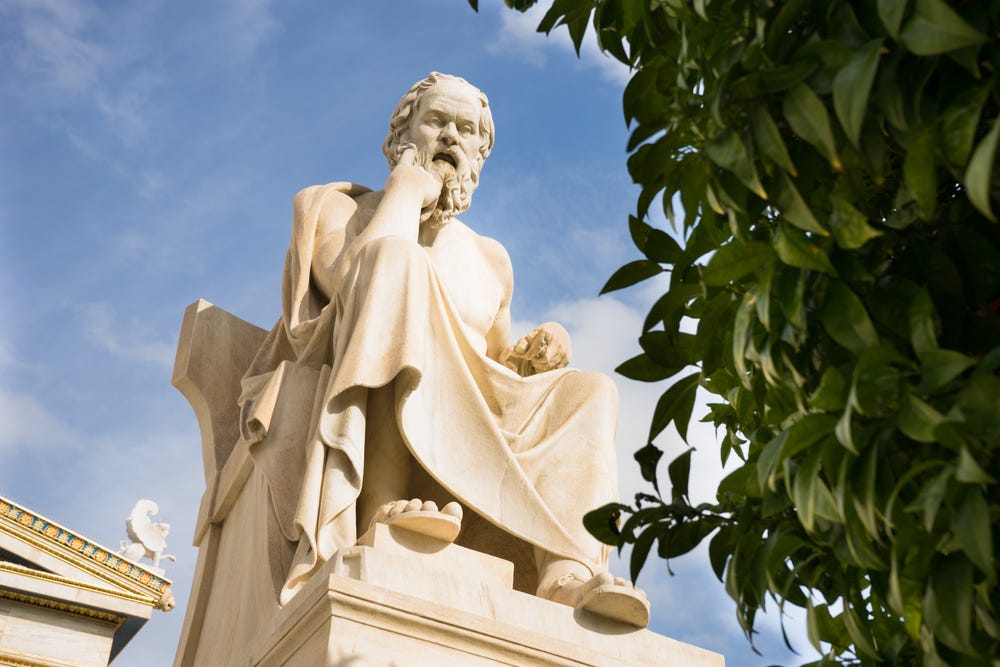
Illustration: statue of Socrates at the Academy of Athens (Shutterstock, licensed).
Karl Popper called optimism a moral duty. The future stays open, so the people making decisions this summer are the ones who will shape it. That is a good thought to hold on to in a season of confident predictions about artificial intelligence.
The statue on this page suggests the method. Socrates worked with questions, and he aimed them at the assumptions nobody had bothered to examine. Ask what a system learned from, who paid for that material, what the numbers actually measure, and who carries the consequences when the answer turns out to be wrong.
This week’s links are full of people. Reporters filing from Tehran through power cuts. A retired librarian in Manizales learning to check a WhatsApp message. A model in Shanghai who refuses to sell the rights to his own face. Editors somewhere in Europe reading machine output line by line to see whether it is true.
One thread connects them. Machines produce answers at scale, and the credibility of those answers comes from people who checked something first. The research this week puts numbers on that dependence for the first time, and the market is only beginning to work out what it owes.
I. On Trust and the Measurement of Visibility
Three signals on where credibility in AI answers comes from, and on how poorly the industry measures its own visibility.
22.1 — Research confirms that AI answers inherit the trust of the brands they cite
New research from the Association of Online Publishers, reported in Press Gazette, finds that an AI answer is trusted almost exactly as much as the sources it cites. In an Ipsos survey of 1,000 people in the United Kingdom, a fully trusted source produces more than 90 percent trust in the answer, a neutral source around 25 percent, and a distrusted source around 10 percent. Almost half of the users who trust the cited source click at least one link.
The same survey found that 37 percent of respondents did not realise AI tools can invent information or sources, rising to roughly 45 percent among 45 to 54 year olds. That is a duty of care for the people designing these interfaces as much as for publishers.
Credibility travels from the newsroom into the answer. The accounting has yet to follow it.
Reflections If citation is what makes an answer credible, how should that credibility be valued in a licensing conversation?
22.2 — A critical survey questions what generative engine optimisation actually measures
Olivier Martinez has published a critical survey of generative engine optimisation covering 45 studies from November 2023 to July 2026, also available on SSRN. His finding deserves the attention of anyone currently buying GEO services. The widely cited gains from the foundational paper hold only where a source already appears in a fixed context, and they establish neither organic discoverability nor lasting traffic effects.
Topical relevance and position in the context window are the most reproducible levers. Generic heuristics transfer poorly between engines, and rewrites designed to win citations can damage retrieval. Commercial audits show low overlap between sources, wide variation from one run to the next, and persistent gaps in fidelity.
Within the reviewed literature, no technique demonstrates a stable, cross platform effect on organic discoverability. An industry is buying a measurement practice that resembles a fairground more than a discipline, and repeated measurements with proper controls are the cheapest possible insurance.
Reflections Which evidence would make a visibility claim solid enough to justify a budget line?
22.3 — Compensation models begin to pay for citation
Perplexity has announced the launch partners for Comet Plus, a five dollar subscription included with its Pro and Max tiers, with Condé Nast, Fortune, Le Figaro, Le Monde, the Los Angeles Times and the Washington Post taking part. Publishers are paid according to human and machine interactions with their content. Steven Brill told Press Gazette that NewsGuard AI shares revenue with publishers and cites them prominently, drawing only on the 12,000 sources it rates as reliable and using 64,000 catalogued false claims as guardrails.
Brill adds a security argument to the commercial one. Large models repeat provably false claims roughly a third of the time when prompted about them, which he attributes in part to coordinated flooding of the web with fabricated articles. Licensing verified reporting and defending against that flood turn out to be the same project.
Scarcity alone preserves nothing. Verified journalism holds its price where organisations can demonstrate use, keep attribution intact and negotiate from a position of leverage, individually or collectively. Claims in court establish the boundaries and negotiations establish workable prices; a sustainable equilibrium becomes possible only when both are done well.
Reflections What contractual terms would make interaction based compensation genuinely auditable for a news publisher?
II. On the People Who Carry the Technology
Three signals on newsroom policy, on investment in staff, and on where the training is coming from.
22.4 — Three newsrooms choose three different paths, and staff report the cost
Erik Bucy and Milad Jalalian Ebrahimi describe in Nieman Lab how Reuters, the BBC and the Guardian have each built a different AI posture. Reuters uses Lynx Insight and Fact Genie to publish some financial alerts in six to eight seconds. The BBC runs its tools behind mandatory human approval, labels assisted content with a hexagon and the phrase “How we used AI”, and published its own research with the European Broadcasting Union showing AI assistants misrepresenting news content 45 percent of the time. The Guardian, under a trust structure since 1936, allowed limited generative use only from March 2026, with permission from a senior editor.
The authors name the cost precisely: a verification tax, the hours editors spend checking machine output. Adaptavist found the same pattern among 2,500 professionals, with 42 percent reporting they spend more time verifying AI output than they save and 65 percent feeling nostalgic for how work ran before generative tools. In the same survey, 67 percent would like their organisation to use more AI, which describes a workforce asking for better implementation.
Ownership shapes policy. Wire services optimise for speed, public broadcasters add oversight, reader funded titles protect the human byline. Each choice is defensible, and each comes with its own bill.
Reflections How would you measure the verification tax in your own newsroom before setting an automation target?
22.5 — Investment in people remains the decisive choice
The Guardian is creating 55 new permanent jobs across the United Kingdom, the United States and Australia in video, audio and data journalism, with Guardian Australia becoming a global hub for social media hosts. Katharine Viner describes the ambition as combining a global reputation for impactful reporting with journalism that is more visual, digital, global and experimental.
Mitali Mukherjee, one year into her directorship of the Reuters Institute, makes the same point from Oxford. She says that the most important resource in news is individuals, and organisations need to invest in them. She also offers a useful idea for smaller teams, asking in how many forms a single story can be told, from audio capsules to video, and she is refreshingly protective of the fellows who pass through the institute.
Mukherjee adds one observation worth keeping. Access to information works as a barometer of privilege, and audiences under thirty reach news through social and video surfaces while still trusting organisations with a record of covering a subject well. That record is built by people.
Reflections Which capabilities deserve permanent headcount in a newsroom that also automates production?
22.6 — Practical guidance and training arrive from Vienna, Nairobi and Delhi
The Austrian Lab for Artificial Intelligence Trust, an initiative of the Austrian innovation ministry run with APA, has published sector reports for healthcare and news media with concrete instructions for safe AI use. The media report asks for an explicit strategy on permitted uses, disclosure to the audience following the principle of too much rather than too little, careful source handling, and labelling with reference to the AI Act. It advises against treating AI mainly as a way to cut costs, which is the most valuable sentence in the document.
Training is arriving from several directions. The Thomson Reuters Foundation has tendered for an AI newsroom consultant to mentor five independent Kenyan media over three to four months, including the drafting of editorial guidelines. The Google News Initiative has opened 50 seats for an AI Skills Program 2.0 in Delhi, combining a workshop with six weeks of mentoring.
Who funds the training shapes what gets taught. That makes the governance of these programmes as interesting as their curriculum, and it is worth noting that the Tarbell Center funds reporting on AI under an editorial independence policy that keeps donors out of the selection.
Reflections What safeguards belong around training funded by the companies whose tools are being taught?
III. On Reporting When Institutions Are Weak
Three signals on verification under fire, on journalism as a civic service, and on audiences learning to check for themselves.
22.7 — AFP reports a war in which a quarter of flagged content is synthetic
AFP has published an account of its coverage of the Middle East conflict that began at the end of February, with simultaneous military operations, internet blackouts and coordinated disinformation. Around 25 percent of the content flagged to its fact checking teams was generated or manipulated with AI, including game footage presented as bombing raids, fabricated images of captured pilots and a staged funeral scene that became the most widely shared piece of misinformation of the conflict. Its OSINT teams verified more than 200 videos from open sources and distributed them to 200 television networks.
AFP credits a Dubai bureau maintained for more than 35 years and a network of sources built over the same period, which is what allowed reporting to continue from Tehran through explosions and outages. Presence like that cannot be improvised once a crisis starts.
A press agency functions as critical information infrastructure in every practical sense during a conflict of this kind. When a quarter of the suspect material is synthetic, verification capacity becomes the product.
Reflections What verification capacity does your organisation need before the next synthetic media crisis reaches your own coverage area?
22.8 — Venezuelan journalists coordinate relief when official information is unavailable
Tony Frangie Mawad describes in CJR how two earthquakes forty seconds apart on 24 June damaged or destroyed nearly sixty thousand buildings, injured more than eleven thousand people and killed at least two thousand, with tens of thousands still missing. Telecommunications collapsed and official registries were unavailable. The only functioning records were open source platforms built by civilians.
His magazine Ecosistema created a platform called Manos a la Mesa to connect restaurants with displaced people who needed a meal. Reporting, coordination and relief work happened at the same desk, by the same people, in the same week.
Where public institutions weaken, the reporting function becomes the register of last resort. Any newsroom writing a crisis protocol should read this account before the next one.
Reflections When a newsroom becomes a coordination platform during a disaster, which editorial standards continue to apply?
22.9 — Audiences train themselves to challenge misinformation
In Manizales, where 21 percent of residents are over sixty, the Universidad de Caldas and the local outlet Pensé que ‘VOZ’ Sabías run a 48 hour course in digital literacy against misinformation for older adults. Participants learn how fact checkers work, they role play as misinformation creators, and they take apart a WhatsApp message that has circulated since 2023 claiming the city could reach 50 degrees. More than 2,000 people were certified in the first year. One of them, a 69 year old retired librarian, says she learned to question what she reads.
The Public Interest News Foundation puts a related question to a much larger institution, asking whether engagement should become the BBC’s newest public purpose. The proposals include accountability sessions where audiences meet the journalists, citizens’ agendas that let the public set election questions, and partnerships with organisations already trusted in their communities. Trust follows from giving power away and keeping promises.
Two ends of the same system. One teaches the audience to verify, the other invites the audience in. Both raise the return on work that was checked by a human being.
Reflections Which audiences in your market get the least support in verifying what they read?
IV. On Governance, Identity and Value
Four signals on the new labelling rules, on rights over faces and styles, on the price of visual content, and on the politics of who gains.
22.10 — Europe’s labelling obligations take effect while the transparency code fills up unevenly
From 2 August, the AI Act requires highly realistic AI generated images, video and audio to be clearly labelled as synthetic. Euractiv reports that nearly 190 companies have signed the accompanying voluntary transparency code, including Anthropic, OpenAI, Google, Meta and Mistral, while large Chinese developers with significant European usage, among them DeepSeek and Alibaba, are absent. Lenovo is the only Chinese signatory.
Platform practice is developing alongside the law. TikTok has announced expanded AI transparency tools across the Middle East and North Africa, reporting more than three billion AI generated videos labelled and a seat on the steering committee of C2PA, the provenance standards body.
A labelling regime works to the extent that labels reach the material people actually see. Uneven adoption leaves visible openings, and provenance standards are the practical instrument for closing them.
Reflections How should a newsroom handle synthetic material arriving from a developer who has not signed the transparency code and whose output carries no provenance data?
22.11 — Faces and writing styles become licensable assets
Rest of World reports that Chinese platforms now pay people between 15 and 700 dollars to license their likeness for AI generated content, with catalogues sorted by age, gender and character type. More than 95 percent of the 128,000 microdramas released in China in the first quarter used AI in production, and ByteDance has removed more than 85,000 videos involving unauthorised reproduction of faces and voices since January. In March the Beijing Internet Court held that using someone’s likeness in an AI face swap without permission is illegal, even where the image has been altered. A 21 year old model in Shanghai, Xu Fang, says he will never license his face, because he cannot know how it might be changed.
A similar boundary is being drawn around writing. Unwire reports that ChatGPT has begun refusing direct requests to reproduce the style of living authors, offering a similar feeling instead, a change linked to the authors’ class action before Judge Sidney Stein in New York. Gemini reportedly complies with such requests, Perplexity refuses, and Claude and Copilot comply with a warning.
The lawyer quoted by Rest of World identifies the weak point exactly: licensing terms so vague that people cannot know who will use their likeness or for what. Consent without scope is a signature without a contract.
Reflections What scope, duration and revocation terms would make a likeness licence acceptable for a journalist who appears on camera?
22.12 — Licensing and automation set two different prices for visual content
Reuters has consolidated its visual licensing, announcing that Reuters Connect is now the single destination for licensing news video and pictures, bringing the Reuters picture collection, Imagn sports imagery and the Screenocean archive into one transactional platform. Alphonse Hardel points to rising demand for factual news visuals from publishers, producers, agencies and creators.
In the same week, Futuri launched a platform claiming that newsrooms cut production time by 80 percent and station costs by more than 15 percent a year, turning a 45 minute press conference into publish ready clips in six minutes and one newscast into 45 social assets, with editors keeping approval rights.
Two prices are being set at once. One is for verified, rights cleared material with a provenance chain. The other is for volume produced from material a newsroom already owns. Both belong in a media business, and the interesting question concerns which of the two a customer thinks it is buying.
Reflections Which parts of your visual output gain value from rights clearance, and which gain value from speed?
22.13 — The social contract around AI is written in policy
Josie Stewart and Brooke Tanner argue for Brookings that policy rather than public relations will determine Gen Z’s trust in AI. About half of Gen Z uses generative AI weekly, while only 14 percent of adults under thirty expect its effect on society to be positive and 69 percent trust work completed by humans more. Their proposed remedies are concrete: consent and compensation for creative labour, portable benefits and wage insurance, disclosure standards for data centres, and stronger protection for minors. Fast Company Middle East tests one distributive idea, asking whether the Gulf could convert AI wealth into guaranteed income.
The institutional version appears in Noema, where a coalition of researchers calls for reverse alignment, the deliberate redesign of institutions so societies can absorb AI. The essay names three failure modes worth memorising: productivity without prosperity, execution without verification, and capacity without constraint.
Execution without verification belongs on a newsroom wall. In four words it covers the verification tax, the fabrication rate in AI answers and the gaps in labelling.
Reflections Which policy commitments would genuinely change how a sceptical twenty five year old judges an AI product?
Conclusion
Read together, these signals describe a machine economy that runs on human judgement. Someone stayed in Tehran. Someone verified the video before 200 broadcasters used it. Someone in Manizales spent 48 hours learning to check a message before forwarding it. Someone in an editing suite read the machine’s draft and found the error. That work is expensive because it takes time and experience, and it is precisely what makes an automated answer worth trusting.
Value does not follow from scarcity on its own. It follows when organisations can show how their work is used, keep their name attached to it and negotiate with something in hand. Litigation, licensing and product innovation are all part of that, and none of them substitutes for the others.
Which brings us back to the statue. Socrates would probably enjoy a language model enormously, as a tireless interlocutor and an excellent mirror for weak reasoning, and he would still insist that reproducing information differs from knowing what to ask. That part stays with us. It is midsummer, the future is open, and the questions are ours to choose.